FREE U.S. SHIPPING · DHL EXPRESS DELIVERY
ARTISAN-MADE IN MOROCCO · LIMITED COLLECTIONS
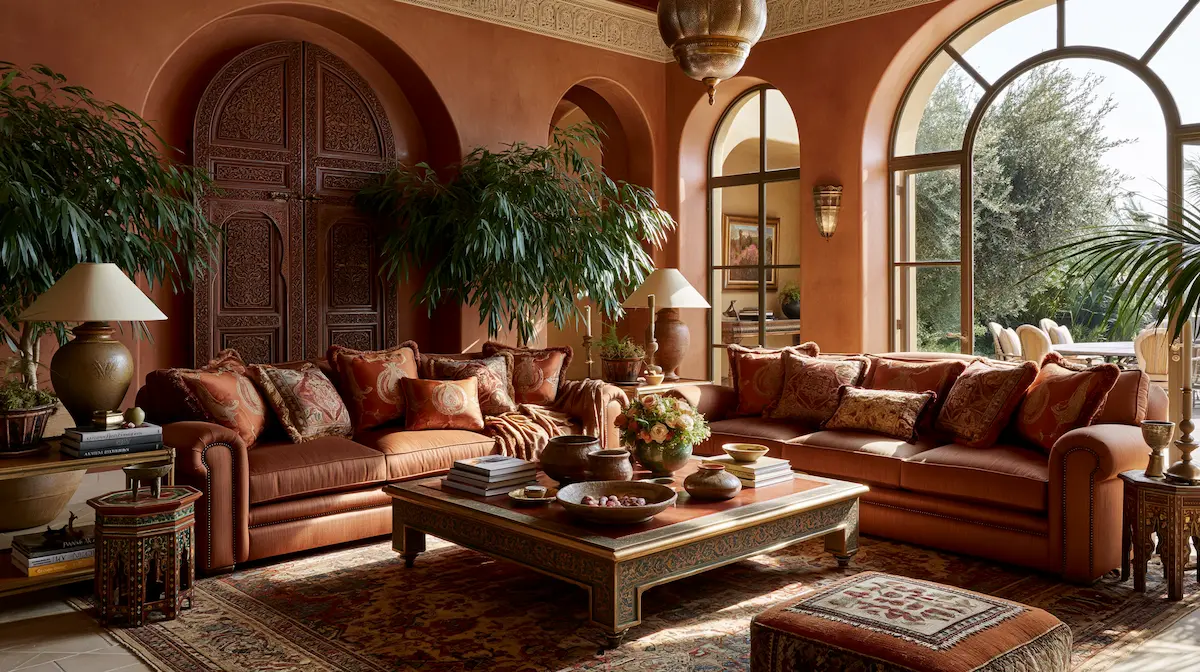
Practical Moroccan interior design ideas for modern homes — from Berber rugs and sabra silk pillows to lanterns and zellige tile.
Most “Moroccan decor” advice falls into one of two traps. Either it hands you a shopping list of poufs and lanterns with no sense of how they fit together, or it leans so hard into the theme that the room ends up looking like a restaurant lobby. This is the guide I wish I’d had when I started: how to get the warmth, depth, and soul of a Marrakech riad in a normal home — without it tipping into costume.
I’ll go through what actually defines the style, the colors that make it work, how to do it room by room, where to start if you’re on a budget, and the small mistakes that make a space read “themed” instead of “collected.” Skip to whatever you need.
If you stripped a Moroccan interior down to its bones, you’d find three things doing all the work: layered texture, warm earthy color, and handmade detail. Everything else — the lanterns, the tiles, the arches — is a bonus on top of those three.
That’s the most useful thing to understand, because it means you don’t need a single “Moroccan” object to make a room feel Moroccan. You need contrast and depth: a flat-woven rug under a plush one, rough plaster against smooth brass, a high-shine silk pillow next to a nubby wool throw. Riads feel the way they do because nothing in them is flat or uniform. Your eye always has somewhere to travel.
The handmade part matters just as much. Moroccan design grew out of craft — rugs knotted by hand in the Atlas Mountains, tiles cut one piece at a time, silk woven on wooden looms. A room full of mass-produced “Moroccan-style” copies misses the point entirely. One genuinely handmade piece does more for the mood than ten printed lookalikes.
This is the question I get asked most, so let me be specific. Moroccan color comes straight from the landscape, and it splits into two families you can mix freely:
The earth tones — saffron yellow, paprika and terracotta reds, cumin and burnt orange, cinnamon brown, sand, taupe, and ivory. These are your base. They’re warm, they’re forgiving, and they make a room feel grounded.
The jewel tones — deep indigo and Majorelle blue, emerald, amethyst purple, and the famous Marrakech rose-pink. These are your accents. A little goes a long way.
The simplest formula that always works: build the room mostly out of warm neutrals (walls, big furniture, the largest rug), then let one or two saturated colors do the talking through textiles — pillows, a throw, a runner. If you want a rule of thumb, the old 70-30 split from interior design is genuinely handy here: roughly 70% calm, neutral base and 30% color and pattern. It keeps the space rich without becoming chaotic.

Here’s the honest answer almost every designer gives privately: start with textiles. Not because they’re the most dramatic, but because they’re the cheapest, lowest-commitment way to shift a room — and they’re the single most authentically Moroccan thing you can add.
A set of handwoven sabra silk pillows will change the temperature of a sofa in about thirty seconds, and you haven’t painted anything or moved any furniture. If it doesn’t work, you swap the covers. Compare that to committing to a tiled backsplash. This is exactly why pillows and poufs are the entry point everyone recommends.
A sensible order to spend, from least to most commitment:

This is where Moroccan style sings. Keep the big furniture simple and neutral, then layer: a rug as the foundation, low seating if you can, a cluster of pillows in mixed sizes, a pouf or two, and one metal lantern or hammered tray for shine. The goal is a space that invites people to sit low, linger, and share mint tea — relaxed and communal, not formal.
A Moroccan bedroom is about envelopment. Layer the bed the way you’d layer a sofa: a textured throw, a few silk pillows in a tight color story, maybe a canopy or a wall hanging behind the headboard. Warm, dimmable light — a lantern or a pierced-metal sconce — does more for the mood than any single piece of furniture.
Small spaces are where you can be bravest, because the commitment is low. A run of zellige tile behind a sink, a stack of hand-painted bowls on an open shelf, a single bold runner in a hallway — these high-impact, low-square-footage moments are the easiest places to introduce real pattern.

This is the part nobody tells you, and it’s the difference between a riad and a theme restaurant:
At its core: handmade textiles and tilework, warm earthy colors lifted by jewel-tone accents, layered textures, intricate geometric and floral motifs, and atmospheric lighting — all arranged to feel relaxed and lived-in rather than showroom-perfect.
A simple balancing guideline: let about 70% of a room be your calm, dominant base (neutral walls, large furniture, the main rug) and about 30% be your accent layer (color, pattern, texture, metallics). For Moroccan style it keeps a rich, layered look from sliding into clutter.
Start with pillows and a pouf, layer rugs you already own, swap one harsh overhead bulb for a warm lantern, and add a metal tray or a few ceramics. You can shift a room dramatically before you ever touch paint or tile.
If you take one thing from all of this: Moroccan style isn’t a checklist of objects, it’s a feeling — warmth, texture, and the visible mark of someone’s hands. Start small and start authentic. A single handwoven rug or a set of real sabra silk pillows can shift the whole energy of a room, and everything else can grow from there.

Discover the Tigemi collection of handwoven sabra silk pillows and start your Moroccan decor journey today →
Each palette below pairs a neutral base with a single accent direction, plus the textile most likely to carry it. Think of this as a cheat sheet for the 70-30 split: the first two columns are your seventy percent, the accent is your thirty.
| Palette | Base colors | Accent | Carry it with |
|---|---|---|---|
| Marrakech Warmth | Sand, ivory, cinnamon | Saffron + paprika | A terracotta sabra silk pillow |
| Riad at Dusk | Taupe, charcoal, brass | Deep indigo | An indigo pillow + lantern glow |
| Atlas Calm | Oatmeal, stone, aged wood | Olive + sage | An olive cushion + flat-woven rug |
| Majorelle Note | Cream, soft grey | Majorelle blue + emerald | A jewel-tone silk pillow, used sparingly |
| Rose of the Souk | Ivory, clay, cumin | Marrakech rose-pink | A rose or amethyst sabra silk cover |
Find the accent textile your palette needs →
Build in layers of three: a foundation layer (the largest rug, the big neutral furniture), a comfort layer (a second rug, throws, low seating), and a soul layer (the handmade textiles and one metal piece that catch the light). Vary the height of the shine: let the gleam of brass sit high, the sheen of sabra silk sit at seating level, and the matte of wool ground the floor. Cluster in odd numbers and mixed scale. And protect the negative space: for every patterned surface, leave a quiet one nearby. A riad feels rich precisely because it knows when to stop.
The fastest, most forgiving way to introduce the soul layer is through pillows. A handmade cactus silk cushion brings color, a natural sheen, and a real Berber motif into a room in seconds, fully reversible. Because the look depends on a gathered, never-matched feel, our pillows are each one-of-one – and our set pricing makes building a coordinated group simple, with ten percent off two, fifteen percent off three, and twenty percent off four or more. To understand the weave you will be living with, the cactus silk care guide covers how to keep the color deep and the cloth soft for years.
Lead with the three things that actually define the style – layered texture, warm earthy color, and visible handmade detail – rather than a checklist of poufs and lanterns. Mix dye lots and sources on purpose, give every busy piece a quiet neighbor, and keep the lighting warm and low.
Let roughly seventy percent of a room be your calm, neutral base – walls, large furniture, the main rug – and about thirty percent carry the color, pattern, and metallics. It keeps a rich, layered look from sliding into clutter.
Textiles. A set of handwoven sabra silk pillows shifts the temperature of a sofa in seconds, with no painting or rearranging. Layer rugs you already own, swap a harsh overhead bulb for a warm lantern, and add a metal tray or a few ceramics from there.
Build on warm earth tones – saffron, terracotta, cinnamon, sand, ivory – then accent with jewel tones like indigo, emerald, amethyst, or Marrakech rose.
Yes. Moroccan rooms are meant to look gathered over time, so a matched set works against the style. One-of-one pieces – each with its own motif and natural dye variation – give a room the collected depth that printed lookalikes cannot. Our set pricing lets you build a coordinated group without sacrificing that individuality.
Bright white overheads flatten everything that makes the style beautiful. Aim for warm, low, layered light – a pierced-metal lantern, a sconce, a few candles – so shadow and pattern have somewhere to play.
Begin with the soul layer – shop handwoven sabra silk pillows, $99, free fast worldwide shipping →