FREE U.S. SHIPPING · DHL EXPRESS DELIVERY
ARTISAN-MADE IN MOROCCO · LIMITED COLLECTIONS
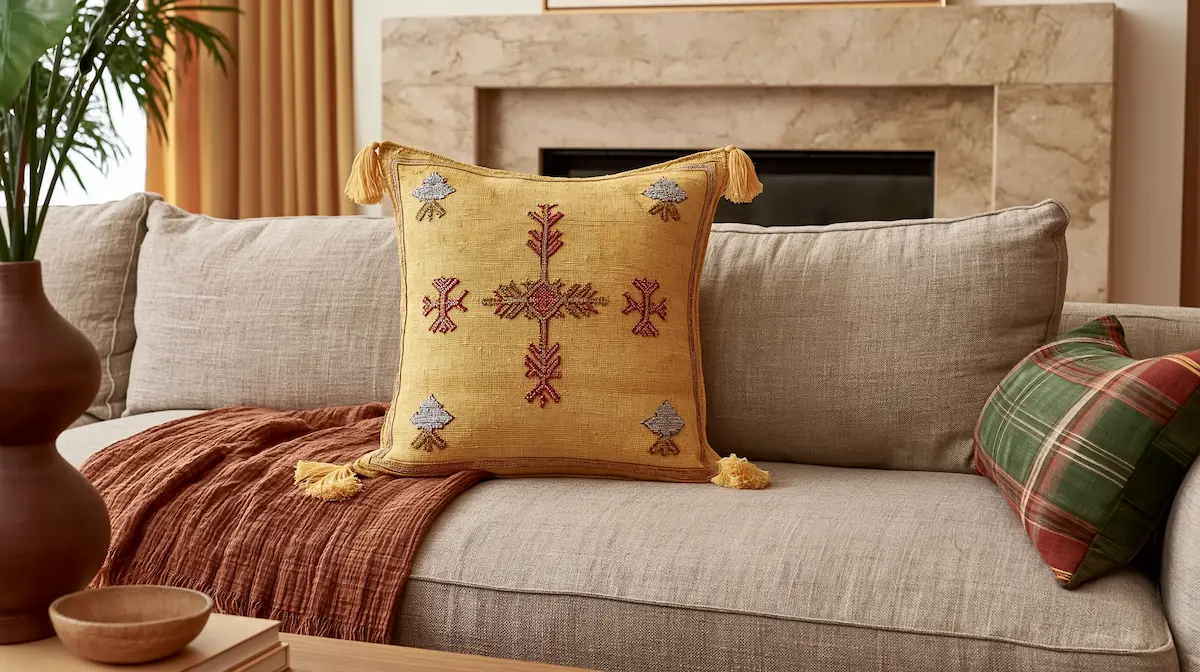
Why handmade artisan throw pillows are the ultimate statement piece — the story of Moroccan sabra silk craftsmanship and sustainable luxury.
Handmade throw pillows are one of the fastest ways to give a room a real focal point. Walk into almost any home-goods store and you’ll find a wall of throw pillows that all whisper the same thing: nothing. They’re fine. They match the rug. They were made by the ten thousand. And there’s a quiet boredom that settles into a room furnished entirely by things that are merely fine.
I’ve spent a long time thinking about why some objects make a space feel alive while others just fill it — and the throw pillow turns out to be one of the most honest tests of that. It’s small, it’s cheap to fake, and yet a single handmade one can reorganize how an entire room reads. This is the case for treating that little square as a statement piece, not an afterthought — and why a hand-loomed Moroccan sabra silk pillow is, for my money, the best version of it you can buy. For room-by-room proportions and palette formulas, use our Moroccan boho pillow styling guide.

A statement piece isn’t just the loudest thing in the room. It’s the object your eye lands on first and keeps returning to — the one that tells a guest, in a second and a half, what kind of home this is. Good rooms usually have exactly one or two of these. More than that and they start competing; fewer and the space goes flat.
Here’s the part most people miss: a pillow is the cheapest, lowest-risk way to place that anchor. You’re not committing to a sofa color for a decade. You’re not painting a wall. You swap a cover, and the room’s center of gravity moves with it. That’s enormous leverage for something that costs less than a nice dinner out.
Mass-produced pillows are designed to disappear. That’s not an accident — it’s the business model. A factory needs every unit identical, the dye lot consistent, the print sharp and repeatable. The result is technically flawless and emotionally empty. Your eye registers it as background and moves on.
Handmade works in the opposite direction. A hand-loomed cactus silk pillow carries the small irregularities of having been made by a person: a slubbed thread here, a color that shifts a half-shade across the weave, a sheen that catches light differently as you walk past. Those “imperfections” are exactly what make your eye stop. We’re wired to notice the hand of a maker. It reads as real, and real is what a statement piece needs to be.

Sabra silk isn’t silk in the silkworm sense at all — it’s fiber drawn from the agave cactus, which is why you’ll also hear it called cactus silk or agave silk. It’s spun, dyed in small botanical batches, and woven on traditional wooden looms in and around Marrakech, largely by women artisans working in cooperatives.
What that means in your living room is a specific, recognizable luster — a soft, almost liquid shine that synthetic “silky” pillows fake badly and never quite get right. Run your hand across it and the texture has a bit of resistance and life to it. It’s the difference between a photograph of a thing and the thing itself.
Because the dyeing happens in small batches with natural pigments, no two covers come out identically. The burnt orange in one runs a touch deeper than the next; a turquoise leans green in daylight and blue at dusk. If you’ve ever bought a “matching set” and felt the room looked a little too coordinated, this is the antidote. The variation is the point.

I’ll be honest about the thing that actually keeps me in this category: every one of these covers is a few days of a real person’s skilled work. The motifs aren’t decoration invented by a marketing team — the Berber diamonds, the twin-flame spears, the XX star corners — they’re a visual language with generations behind them. When you put one on your couch, you’re keeping a craft economy alive and giving a centuries-old vocabulary a place to keep being spoken.
You don’t have to care about that to enjoy the pillow. But in my experience, the people who do end up loving the object more, not less — because now it has a story they can actually tell.
The most common mistake is buying a beautiful handmade pillow and then burying it under five other busy patterns. A statement piece needs breathing room. A few rules that have never let me down:
Give it a quiet neighbor. Pair one bold hand-loomed cover with a solid linen or a plain textured weave in a calm tone. The plain one makes the special one look more special.
Odd numbers, varied sizes. Three pillows in two sizes almost always beats four matched ones. Let the handmade piece be the largest or the most centered.
Match a mood, not a color. You’re not hunting for the exact shade in your rug. You’re picking something that shares a feeling — warm with warm, earthy with earthy — and letting the contrast do the work.

If you just want something to fill a corner of the couch, no — buy the ten-dollar one and don’t think about it again. But if you want a single object that changes how a room feels, that gets noticed, that you’ll still like in five years, and that came from a real pair of hands rather than a mold — that’s a different question, and the answer is yes.
A statement piece earns its name by being the thing you’d grab first if you were starting the room over. A hand-loomed Moroccan sabra silk pillow is one of the very few things at this price that genuinely qualifies.

If the case for a handmade statement piece still feels abstract, this is where it gets concrete. The two paths diverge on almost everything that determines how a pillow makes a room feel.
| Quality | Handmade sabra silk pillow | Mass-produced pillow |
|---|---|---|
| How it is made | Hand-loomed over days by an artisan | Printed and cut by the thousand |
| Uniqueness | One of one – never repeated | Identical to thousands of others |
| Texture and sheen | Living, light-catching, slubbed | Flat, uniform, reads as background |
| How the eye reacts | Stops and returns to it | Registers it and moves on |
| Aging | Develops patina and character | Fades, pills, looks tired |
| Who it supports | A living artisan craft economy | A factory supply chain |
| Story to tell | Maker, region, and motif | None |
There is a quiet financial logic to making the pillow your anchor rather than your afterthought. A sofa is a decade-long commitment and a wall of paint is a weekend of work; a cover is neither. For the price of a nice dinner, you can move the entire visual center of a room – and then move it again next season without redecorating. A handmade piece also holds its presence far longer than a printed one: because the appeal lives in the weave and the natural-dye depth rather than in a trend-driven print, it does not date the way fast-decor does. If you are anchoring more than one seating area, our set pricing makes building a collection gentler on the budget – two eligible covers save 25%, three save 33%, four save 35%, and five or more save 40% automatically in the cart.
Yes – that is exactly the point of a statement piece. Place one bold, handmade cover against quieter neighbors and it becomes the object the eye lands on first, which reorganizes how the entire space reads for a fraction of the cost of any other change.
Usually one or two. More than that and they compete; fewer and the space can fall flat. Let the handmade piece be the largest or most central, and give it calm, solid-toned companions.
Because we are wired to notice the hand of a maker. The small irregularities of hand-weaving – a slubbed thread, a half-shade color shift, a sheen that moves as you pass – are what make the eye stop. Technical perfection reads as background.
For an object that restyles a room, lasts for years, and comes from real hands rather than a mold, it is one of the few things at this price that genuinely qualifies. Compared with committing to a new sofa or rug, it is remarkably low-risk.
No – because each cover is one of one and naturally dyed in small batches, even a set varies gently from piece to piece. You get cohesion without the over-coordinated, bought-as-a-bundle look.