FREE U.S. SHIPPING · DHL EXPRESS DELIVERY
ARTISAN-MADE IN MOROCCO · LIMITED COLLECTIONS
A practical buying guide to spotting authentic handmade Moroccan sabra (cactus) silk pillows — fiber, weave, dye, makers, and fair price — and avoiding cheap dupes.
Moroccan cactus silk pillows are everywhere right now, and where there is demand there are imitations. Search any marketplace and you will find piles of “Moroccan” cushions for the price of a sandwich. So before you spend real money, it is worth knowing how to tell a genuine handmade piece from a printed dupe. After years of handling these textiles, here is the checklist I actually use.
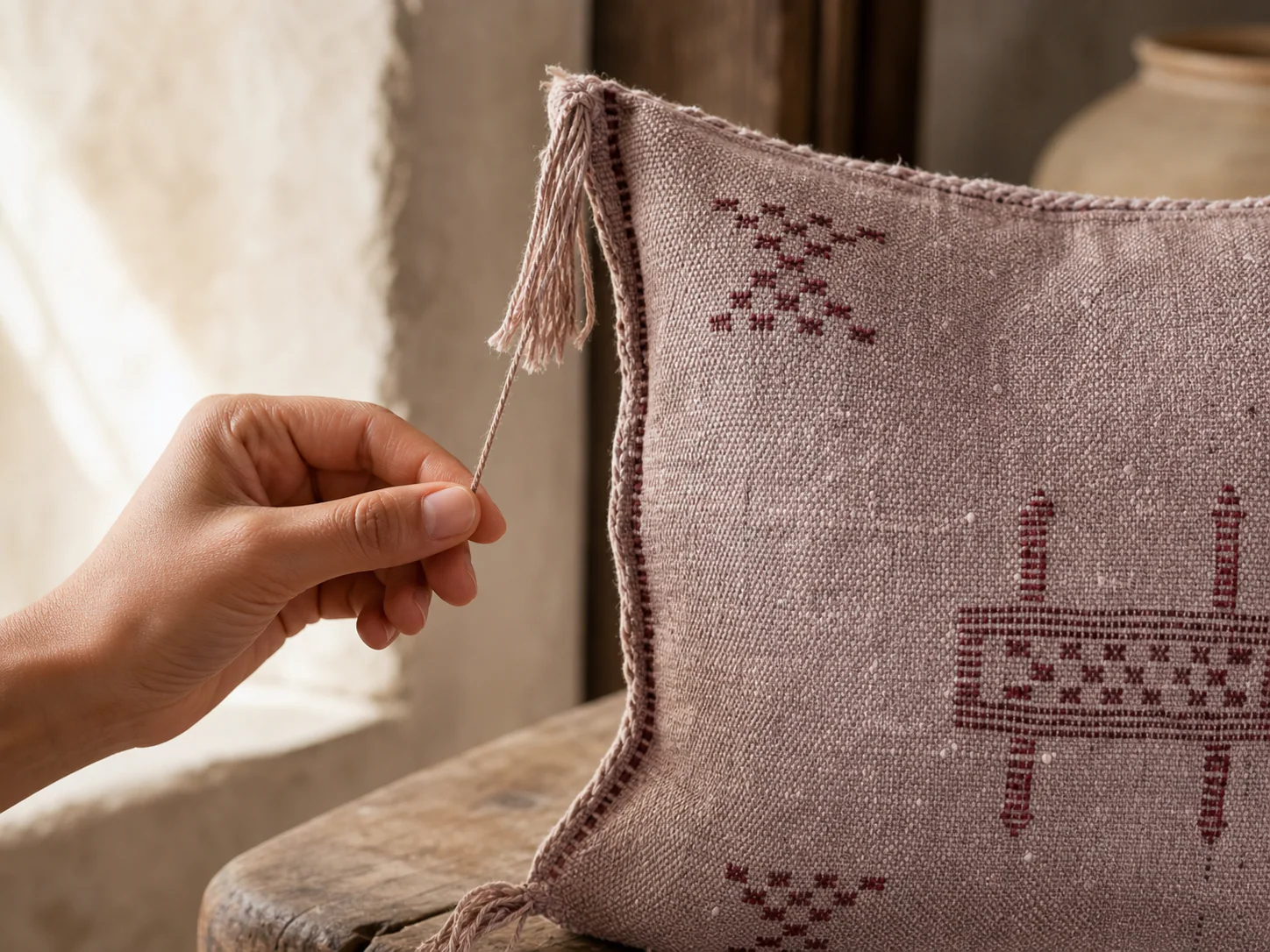
Sabra silk, cactus silk, and vegetable silk are trade terms that sellers use inconsistently. A trustworthy seller should explain what they know about the material, weave, dyes, origin, and care without presenting a marketing label as a laboratory certificate. Ask for close-up photos of the front, back, seams, and tassels, then compare those details with our Sabra textile guide.
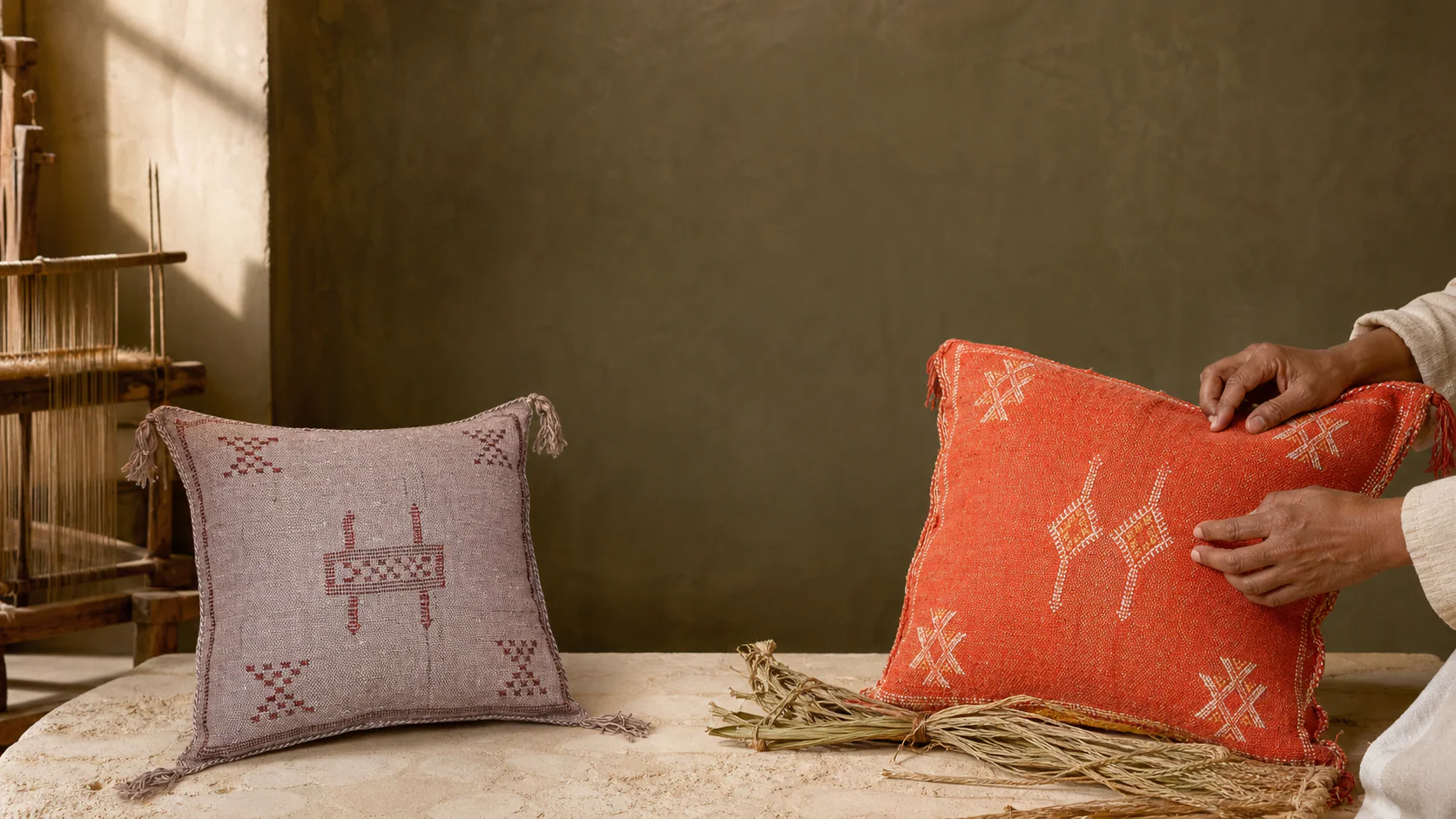
Handwoven cloth is never perfectly uniform. Look for gentle irregularities and a soft natural sheen that catches the light. Natural dyes such as saffron, henna, and indigo shift subtly as you move the pillow, while printed polyester stays flat and identical edge to edge. And on a real piece, the Amazigh motifs are woven or hand-embroidered into the cloth, not stamped on top.
Authenticity has an address. A genuine maker can tell you the community and region a pillow comes from. Ours are sourced directly from named Amazigh weaving communities in the Atlas Mountains and Tazenakht. If a brand cannot name a region or a maker, be cautious.
Here is the easiest tell of all. If a “Moroccan” pillow is available in unlimited quantity at a throwaway price, it was not handmade. True sabra silk pieces are one of one — when a particular pillow sells, that exact piece is gone for good.
Handwoven, naturally dyed, one-of-a-kind work usually sits somewhere around $90 to $250 and up, depending on size and detail. For reference, our launch price is $99 (rising soon), it ships quickly by DHL Express, and it is backed by a money-back guarantee. See the collection →
Every Tigemi pillow is handwoven by Amazigh artisans, dyed with natural pigments, finished with hand-knotted tassels, and genuinely one of a kind. No two are the same, which is rather the point.
Buy with clarity
Hand-finished in Morocco · One-of-one pieces · Free U.S. DHL Express shipping · 30-day return promise
Shop authentic Moroccan cactus silk pillows — $99, one of one →
If you only have thirty seconds with a pillow before you decide, run it against this. Genuine handmade cactus silk passes most or all of these; a printed dupe fails almost all of them.
| What to check | Authentic (Sabra tradition) | Likely a dupe |
|---|---|---|
| Material disclosure | Clear description, close-ups, and honest sourcing details | Vague “silky” label with no supporting details |
| Weave | Gentle irregularities, visible hand | Perfectly uniform, machine-flat |
| Sheen | Soft luster that shifts in light | Flat or plastic-shiny, unchanging |
| Color | Natural-dye variation across surface | One flat, identical printed tone |
| Motifs | Woven or hand-embroidered in | Printed flat on top of the cloth |
| Maker story | Named region and community | No origin, no maker |
| Availability | One of one – sells out for good | Unlimited stock, any quantity |
| Price | Roughly $90-$250+ | $15-$30 throwaway |
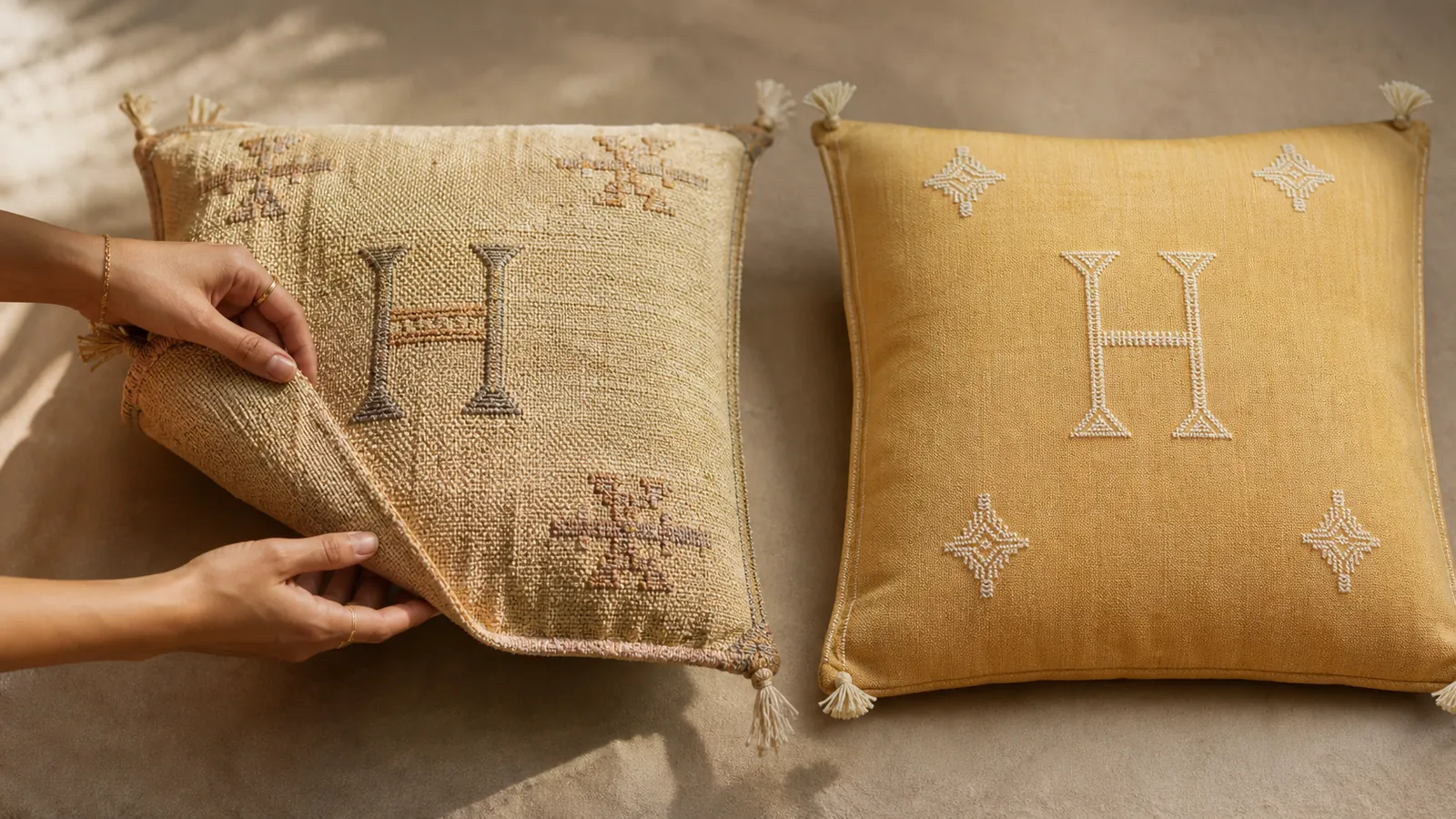
First, inspect the reverse, seams, and tassel joins in bright natural light. Handwoven cloth should show the construction and small variations continuing through the textile; a printed imitation often reveals a flatter reverse or a motif that sits only on the surface. Second, tilt the cloth under a lamp and move it slowly. Handmade weave produces a broken, changing luster rather than one uniform plastic shine. Avoid water, burn, or pull tests—those can damage the piece and do not prove fiber content.
Honestly, no – short of lab testing, and even then this category has a known labeling problem where rayon is sometimes mixed in or mislabeled. That is exactly why we focus on what you can verify by hand: weave irregularity, natural-dye behavior, sheen, and a real maker story. We describe ours as woven in the Sabra tradition for that reason.
It means the specific piece you are looking at is the only one of its exact pattern and color. When it sells, that design is gone – we do not re-run it. It is the opposite of a warehouse of identical units.
No – a faint transfer is normal and is actually a sign of genuine, unfixed botanical dye. It is also why you keep these covers away from water in daily care. A piece that transfers nothing at all is more likely synthetic.
Because they are machine-printed polyester made by the thousand, not handwoven by an artisan. Genuine handwoven, naturally dyed, one-of-one work cannot be produced at that price. The bargain is the warning sign.
Not on its own – price is one signal among several. Run the full checklist: fiber transparency, weave, dye variation, woven-in motifs, and a named maker region matter more than the number on the tag.