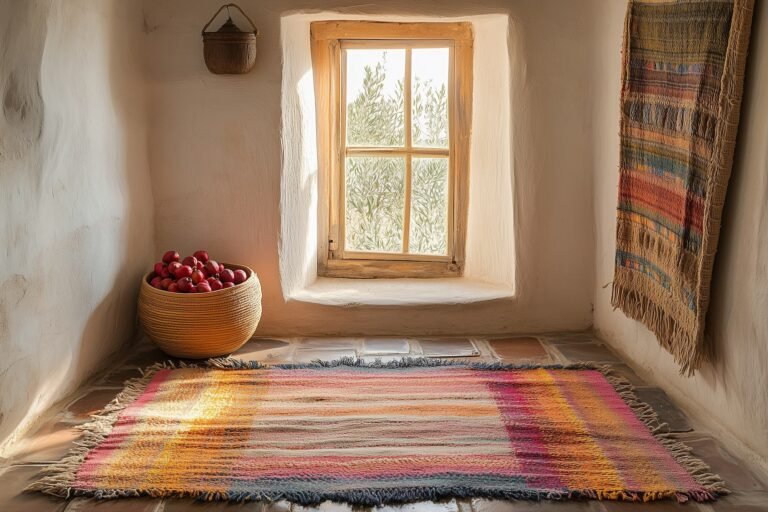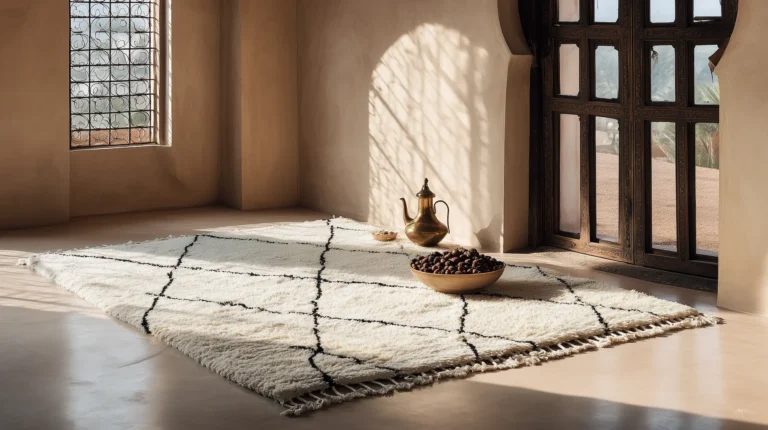
FREE U.S. SHIPPING · DHL EXPRESS DELIVERY
ARTISAN-MADE IN MOROCCO · LIMITED COLLECTIONS
Discover Azilal rugs: Morocco's most artistically expressive Berber rug tradition. Complete guide to natural dyes, symbols, authenticity, styling, and collecting.
Between the cedar forests of the Middle Atlas and the snow line of the High Atlas lies a province called Azilal — a region of steep valleys, almond trees, and Berber villages where women have been weaving a specific kind of story for as long as anyone remembers. Azilal rugs are neither the architectural silence of the Beni Ourain nor the wild improvisation of the Boucherouite. They sit between those two poles, carrying a language all their own: ivory grounds softened by hand-dyed colors, loose geometric compositions, and small pictorial figures that feel less like decoration than like diary entries woven into wool.
This guide is a complete introduction to Azilal — where the tradition comes from, how the rugs are made, what the colors and symbols mean, how to tell an authentic piece from an imitation, and how to live with one at home. Whether you are considering your first Moroccan rug or building on an existing collection, understanding Azilal will sharpen your eye for everything else.
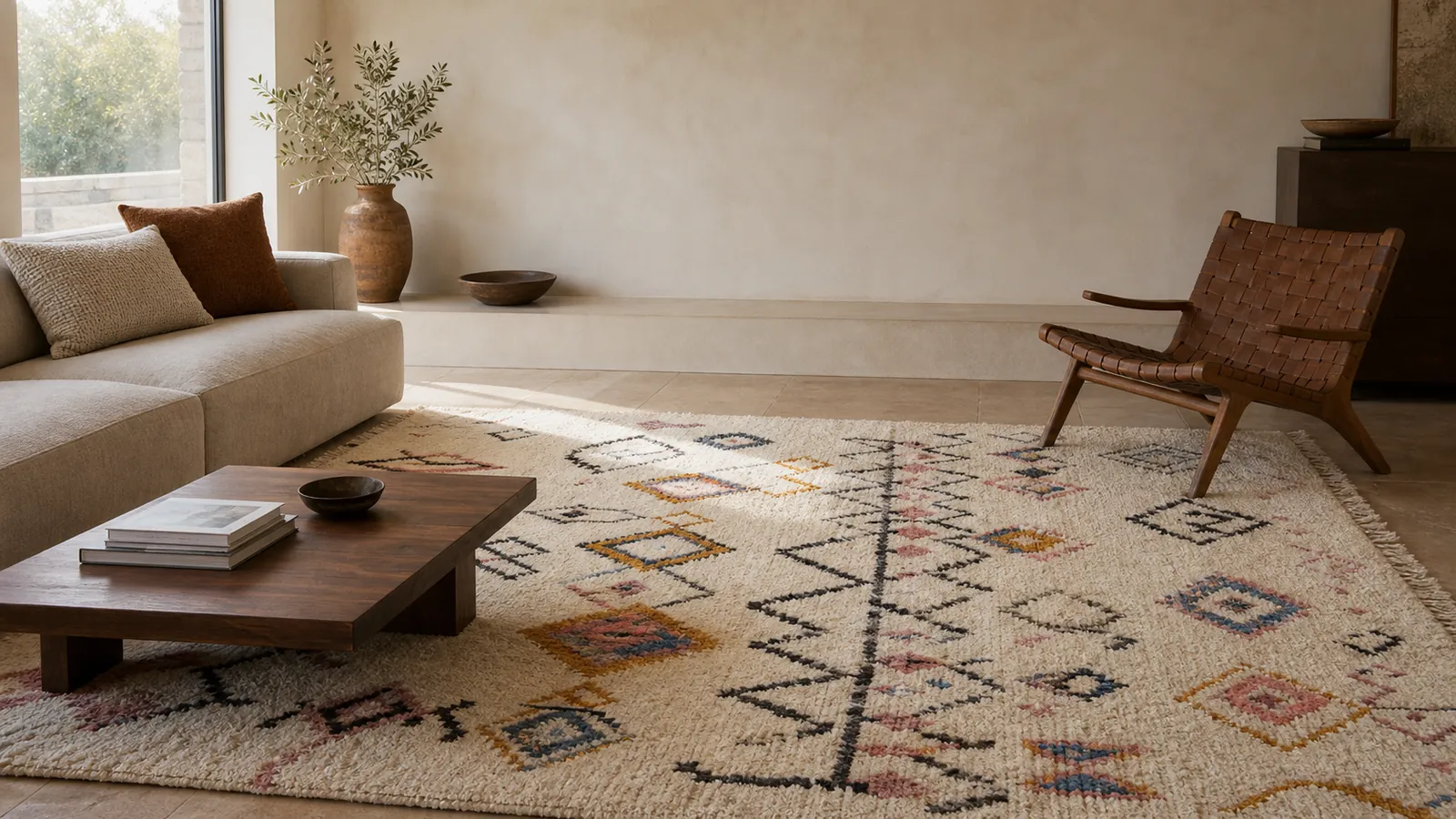
An Azilal rug is a handwoven wool pile rug made by the Berber tribes of the Azilal province in the central High Atlas Mountains of Morocco. The defining characteristics are immediately recognizable once you have seen a few: a natural ivory or cream wool ground, colorful abstract and pictorial motifs using natural vegetable dyes, a medium pile that is neither shaggy nor flat, and compositions that are looser and more narrative than the strict geometries of Beni Ourain.
Unlike Beni Ourain, where weavers limit themselves to ivory and dark natural wool, Azilal weavers embrace color — but always with restraint. A typical Azilal rug contains three to six colors against an ivory field: ochre, madder red, indigo blue, walnut brown, saffron yellow, and the occasional cochineal pink. The effect is warm without being loud, personal without being chaotic.
Azilal is a province of around half a million people in the central Moroccan Atlas, stretching from the Ait Bouguemez valley in the north to the edges of the Ouarzazate desert in the south. The terrain is dramatic — rivers cutting through red sandstone, forests of juniper and holm oak, herds of sheep and goats moving between summer and winter pastures. The tribes of this region, primarily Ait Bouzid and Ait Bouguemez, have been weaving since long before written records began documenting Berber craft.
For most of the twentieth century, Azilal rugs remained almost invisible outside their region. Unlike Beni Ourain, which was adopted by mid-century modernist architects in Paris and New York, Azilal stayed local — woven for weddings, for daughters leaving the family home, for winter floors, for the walls of a newlywed couple’s first bedroom. International recognition came only in the 2000s, when a small number of dealers and collectors began to notice that these rugs carried something no mass-market textile ever could: a visible human hand, an unmistakable personal voice.
Today, Azilal is considered one of the most collectible of the Moroccan rug traditions. Museum exhibitions in Europe and the United States have featured Azilal pieces, and strong vintage examples from known weavers increasingly appear in serious design auctions.
The making of an Azilal rug combines the material seriousness of Beni Ourain with a level of compositional freedom closer to Boucherouite. It is the most artistically expressive of the traditional wool rug techniques, and it is the reason no two Azilal pieces ever look alike.
The wool comes from the family’s own flock or from a neighbor’s, shorn each spring in the mountain villages. Azilal sheep produce a medium-length fleece that is softer than Middle Atlas wool but not quite as fine as the wool of the coastal plains. Sorting by color and length happens at home, by hand, over several days.
This is the step that most sharply distinguishes Azilal from other Moroccan rug traditions. While Beni Ourain weavers use only undyed wool and Boucherouite weavers work with already-dyed recycled fabric, Azilal weavers dye their wool themselves, using plants and minerals from the surrounding mountains. Madder root for red. Indigo for blue. Walnut shells for brown. Henna for orange. Pomegranate skin for soft yellow. Each color is a small domestic project — wool simmered in a pot over an open fire, stirred for hours, rinsed and dried outdoors. Natural dyes age beautifully; synthetic dyes do not. This is why a ten-year-old Azilal looks better than a brand-new one.
 Moroccan wool skeins in natural colors: rust red, indigo, ochre and ivory”/>
All Azilal yarn is hand-spun on a drop spindle. The slight irregularities in thickness create the characteristic texture of the finished pile. Machine-spun wool produces a flat, uniform surface that reads as artificial the moment sunlight touches it. Hand-spun yarn catches light differently across every square centimeter, giving the rug its living quality.
Azilal weavers often begin with a rough intention — a color palette, a few motifs they want to include, perhaps a border structure. But the composition is finalized row by row, over months of work. A diamond planned for the center may migrate to the lower third of the rug. A stripe of indigo may stop halfway across because the weaver ran out of dyed wool that day. These are not mistakes. They are decisions, and they give Azilal its particular alive-ness.
Once the rug leaves the loom, the fringes are hand-knotted and the piece is washed briefly in cold water — a stream, a basin, sometimes a bathtub — to settle the pile and open the wool fibers. It is then laid out in the sun for two or three days. The sun-wash softens the natural dyes into their final harmony and gives the ivory its warm, living tone.
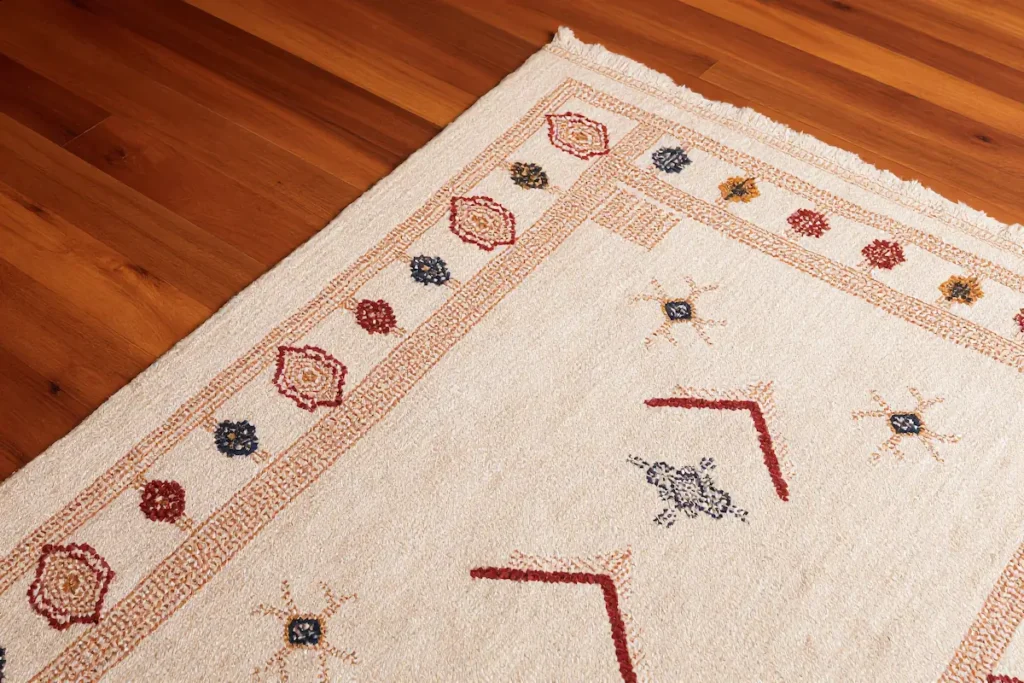
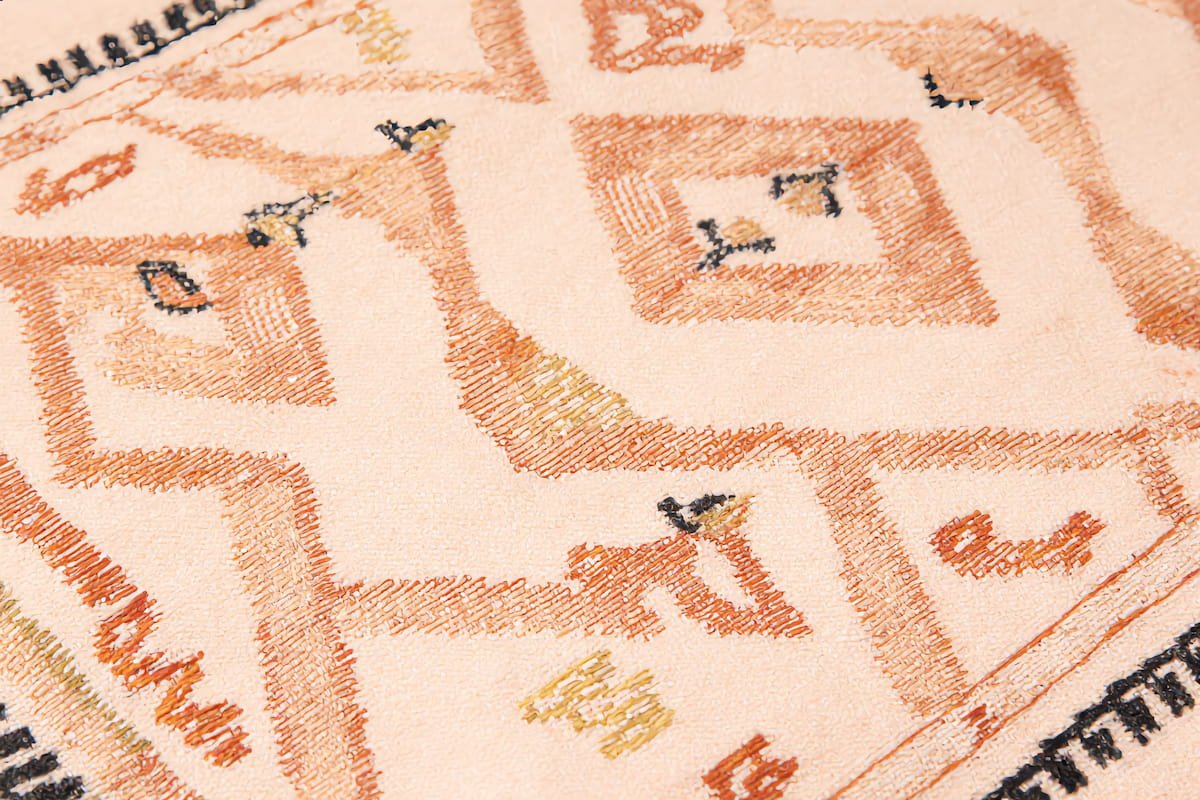
Azilal rugs share the Berber symbolic vocabulary that runs through every Moroccan rug tradition, but they use it more narratively than their neighbors. Where a Beni Ourain might place a single diamond in a field of ivory and let it carry an entire meaning, an Azilal will often include a small pictorial scene — a figure, an animal, a house, a comb — floating in the same field. The effect is closer to an illuminated manuscript than to abstract art.
Reading an Azilal is a skill that deepens with time. The first viewing shows you color. The second viewing shows you shapes. The tenth viewing shows you a story.
If you are comparing the three great wool rug traditions of the Moroccan Atlas, here is a quick orientation:
A useful way to choose: Beni Ourain if you want the rug to recede into the room, Azilal if you want the rug to be a quiet conversation partner, Boucherouite if you want the rug to be the reason people stop at the door.
The design world has spent two decades chasing whatever Beni Ourain used to be before mass-market imitation hollowed it out. Azilal has quietly absorbed some of that attention. Three reasons explain why serious collectors have turned to it:
Because Azilal has only recently entered the international market, imitations are still rarer than for Beni Ourain — but they exist, especially among machine-tufted rugs sold under generic “Moroccan” labels. A few reliable tests:
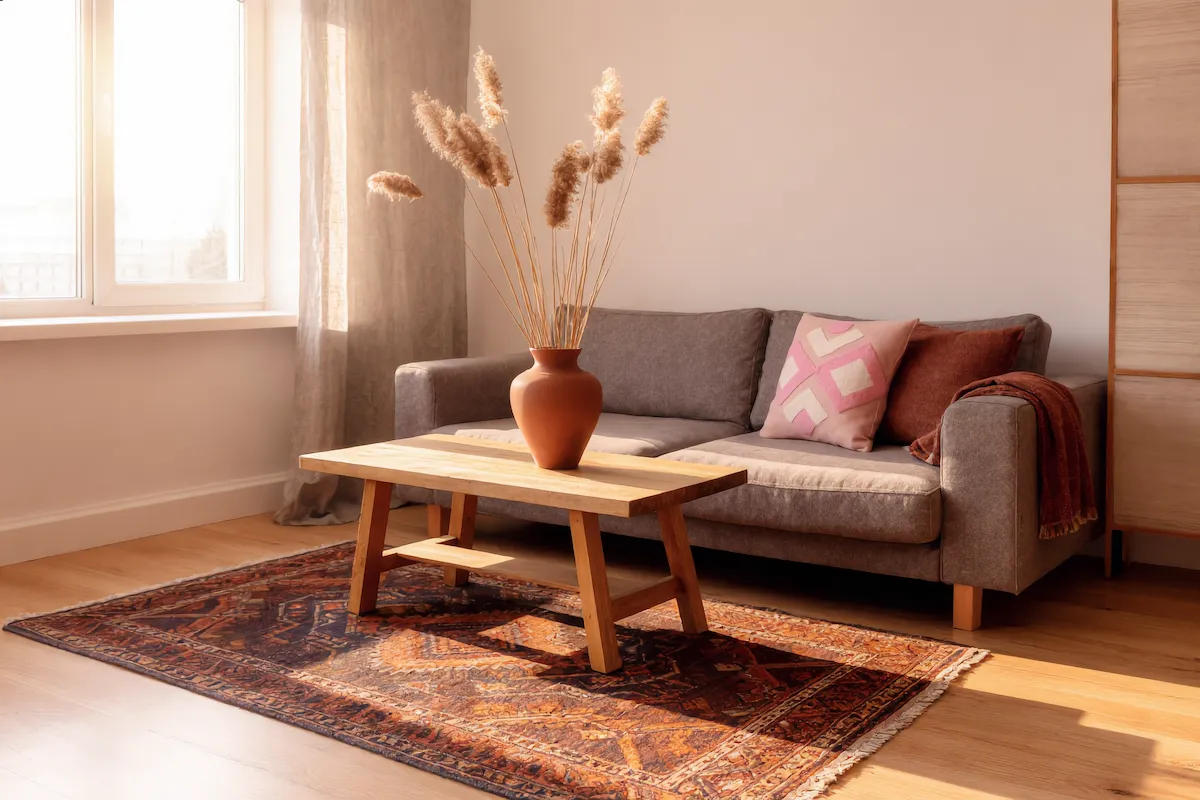
Azilal is forgiving but expressive. It asks for a home that lets it speak without competing with it. A few principles from our own work:
Azilal care follows the standard principles of hand-knotted wool rug care, with one important addition: natural dyes are more light-sensitive than synthetic ones. A few essentials: vacuum gently without a beater bar, rotate the rug every six months, avoid direct prolonged sunlight on any single area, blot spills immediately with a dry cloth, and trust only specialists who explicitly work with natural-dyed wool for deeper cleaning. Never use bleach, strong detergents, or general carpet steaming services.
Kept carefully, an Azilal will improve for a century. We have seen rugs from the 1950s still in family homes in the Atlas, their colors deeper and more harmonious than the day they left the loom.
Because Azilal production is still almost entirely household-based, the chain of custody between the weaver and the buyer has historically been short — but it can also be exploitative if it passes through too many middlemen. The weaver of an Azilal rug spends three to six months on a medium-sized piece. She sources her own wool, dyes her own yarn, designs her own composition, and carries the economic risk if the rug does not sell. When you buy directly from a cooperative or from a brand with transparent weaver relationships, a meaningful share of the price returns to her village and her daughter’s education.
At Tigemi, every Azilal in our collection is sourced from named weavers in the Ait Bouguemez and surrounding valleys. We pay for the time, the skill, and the risk — not just the rug.
Authentic, hand-knotted, natural-dyed Azilal rugs typically range from €600 for small contemporary pieces to €4,000 or more for large vintage pieces from known weavers. Very cheap rugs sold as “Azilal” under €200 are almost always synthetic imitations.
Both. The tradition is alive — new rugs are woven every year in the Azilal province. Vintage pieces from the 1960s through the 1990s are more collectible because their natural dyes have aged and deepened over decades. Contemporary rugs offer fresh palettes and newer wool.
Natural dyes soften over time, especially with exposure to strong sunlight. This softening is generally considered a positive evolution rather than fading — the colors become more harmonious. Rotating the rug every six months ensures even aging.
Yes, and many families do. Natural wool and plant-based dyes are among the safest textile materials for children. Azilal rugs are traditionally woven for weddings and new homes, which in Berber culture often means they are made with children specifically in mind.
No. Color alone is not the marker. An Azilal specifically comes from the Azilal province, uses natural dyes on an ivory wool ground, and follows the narrative compositional style of the region. Colorful rugs from other regions — Boucherouite, Boujad, Taznakht — belong to different traditions with different techniques and meanings.
Of the three great Moroccan wool traditions, Azilal is the one most people discover last and love longest. Beni Ourain is the first purchase. Boucherouite is the surprise. Azilal is the rug you keep for life.
It contains color without chaos. It carries story without nostalgia. It improves with age. It was made by a specific woman in a specific valley in a specific year, using wool from specific sheep and dyes from specific plants that grew on the specific slopes around her home. Nothing about it is generic. Nothing about it is replaceable. And nothing else on your floor will ever feel quite the same as the day you bring it home, unroll it, and meet, for the first time, the quiet company of a thousand small decisions the weaver made on your behalf.
This is what a hand-dyed, hand-spun, hand-knotted, hand-designed rug actually means. This is an Azilal.
Both begin with an undyed ivory ground, but where Beni Ourain stays architectural and restrained, an Azilal opens up into color and narrative. Azilal weavers work in looser, more personal compositions – flashes of naturally dyed pink, saffron, indigo, and rust, irregular motifs, and a lighter pile.
Almost always. Azilal weaving is famously improvisational; the weaver composes as she goes, without a fixed plan. Two rugs from the same loom will diverge in color and rhythm. This is exactly why collectors prize them.
Traditionally, the landscape itself: madder and henna for reds and rose, indigo for blue, pomegranate and saffron for golds, walnut husk for brown. Naturally dyed pieces mellow gracefully over time rather than turning garish.
Because they sit at the rare intersection of genuine folk art and livable design – rich enough in color and symbolism to read as artwork, restrained enough in their ivory ground to live in a modern home.
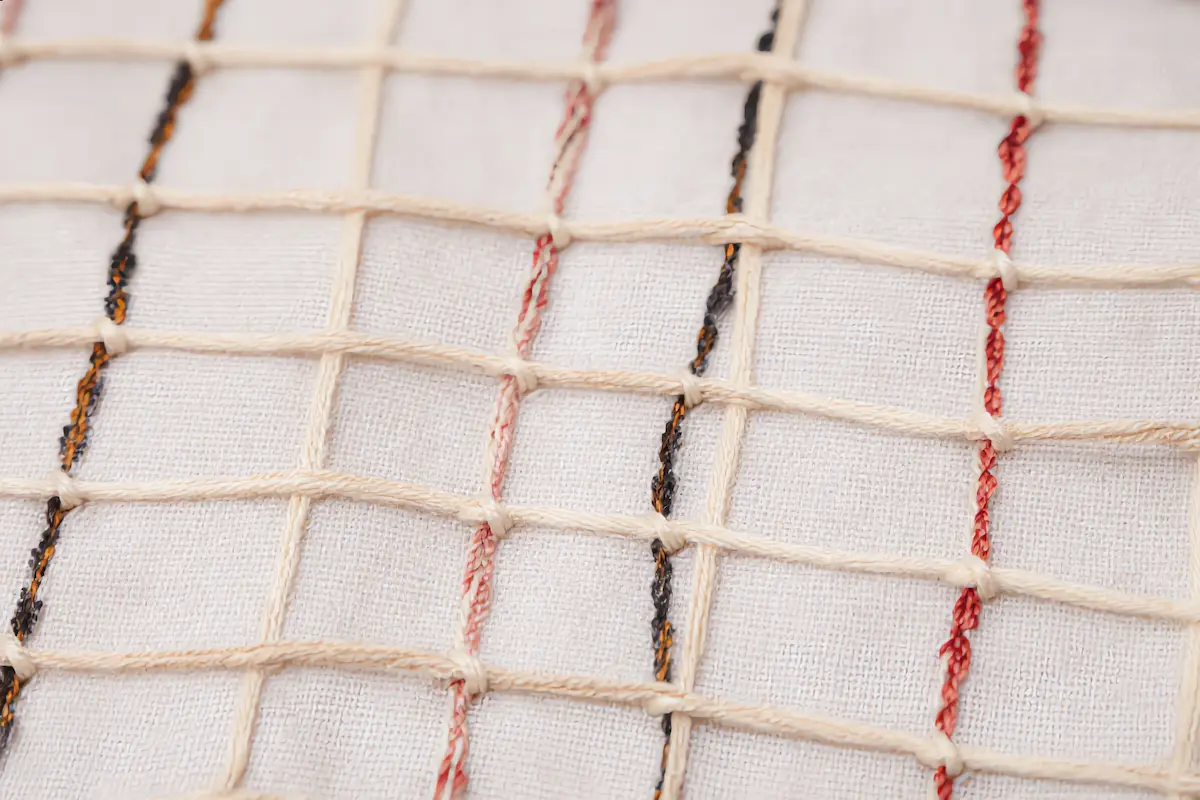
An Azilal carries its own color story, so the textiles around it should echo rather than compete. We often pull one accent tone from the rug – a madder red, a saffron gold – and repeat it at sitting height with a handwoven Sabra silk pillow. Explore our one-of-one Sabra silk pillows to find a shade that draws your Azilal’s palette up off the floor; each is $99 with free worldwide shipping.