FREE U.S. SHIPPING · DHL EXPRESS DELIVERY
ARTISAN-MADE IN MOROCCO · LIMITED COLLECTIONS
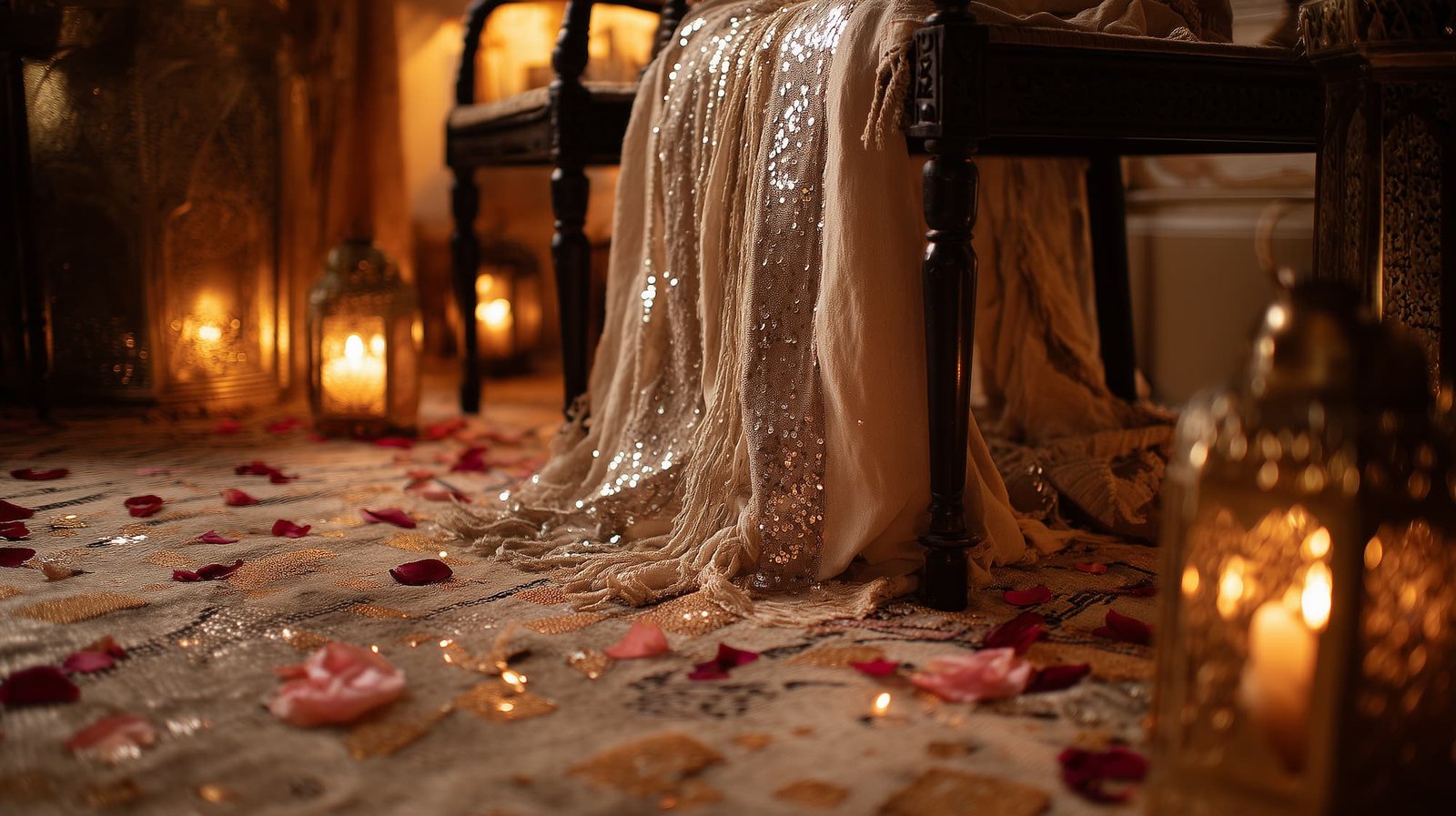
Discover the handira: Morocco's iconic Berber wedding blanket. Complete guide to origin, sequin symbolism, authenticity markers, styling, care, and collecting.
On the morning of her wedding, in a village high in the Middle Atlas, a young Berber bride is wrapped in a textile she has never worn before and will never wear again. It is white wool, heavy with thousands of small sequins, embroidered with dark geometric symbols her aunts and grandmothers have been placing on these cloths for longer than anyone in the village can remember. Under this blanket, she is protected. Over it, she is seen. After the wedding, she folds it carefully and puts it away, because the blanket now belongs to her future — to a daughter, to a granddaughter, to a moment decades from now when it will be unfolded again. This textile has a name: handira. And it is one of the most extraordinary objects ever produced by human hands.
This guide is a complete introduction to the handira — its origin in Berber wedding tradition, how it is made, what the sequins and symbols mean, how to recognize an authentic piece, how to use one in a contemporary home, and why, in the last two decades, the handira has quietly become one of the most collected Moroccan textiles in the world outside of rugs.
A handira is a handwoven wool blanket traditionally made by Berber women of the Middle Atlas region of Morocco as a ceremonial cloak for a bride on her wedding day. The word itself is the generic Moroccan Arabic and Berber term for a thick wool covering, but when used internationally today, handira almost always refers specifically to the wedding version — a particular kind of blanket marked by three defining features: a field of natural undyed wool (usually ivory or cream), hand-embroidered geometric motifs in dark wool or colored thread, and thousands of tiny metallic sequins sewn in rows or patterns across the surface.
The handira is a cloak first and a blanket second. On the wedding day, the bride wears it draped over her head and shoulders as she is led from her family’s home to her new husband’s. The sequins flash in the sunlight; the symbols protect her; the weight anchors her. Only after the ceremony does the handira enter its second life as a family heirloom — sometimes used as a bed covering, sometimes folded in a cedar chest for decades, sometimes, in our century, hung on a wall in Paris or New York as a piece of textile art.
The handira tradition is rooted in the Zemmour and Zaiane tribes of the Middle Atlas, particularly in the region around Khenifra and the surrounding villages. These are Berber communities whose weaving heritage stretches back at least a thousand years, and whose wedding customs preserve rituals that predate Islam in the region.
In traditional Berber life, a young woman begins preparing her handira long before any wedding is arranged — sometimes in her early teens, as part of a broader trousseau of textiles that will accompany her into marriage. The blanket is often woven collaboratively by the bride, her mother, her aunts, and her close female relatives, over months or years. The process is part craft, part ceremony, part extended lesson in the women’s visual language of the community. By the time the handira is finished, it has recorded not only the bride’s skill but the collective hands of the women who raised her.
Until the 1990s, handiras rarely left their villages. They were private objects, made for private rituals, kept in private homes. International recognition came slowly, through dealers and collectors who began to understand that these blankets were not just folk craft but a sophisticated textile tradition with its own symbolic grammar. Today, vintage handiras from the Zemmour region are among the most sought-after Moroccan textiles in the international market.
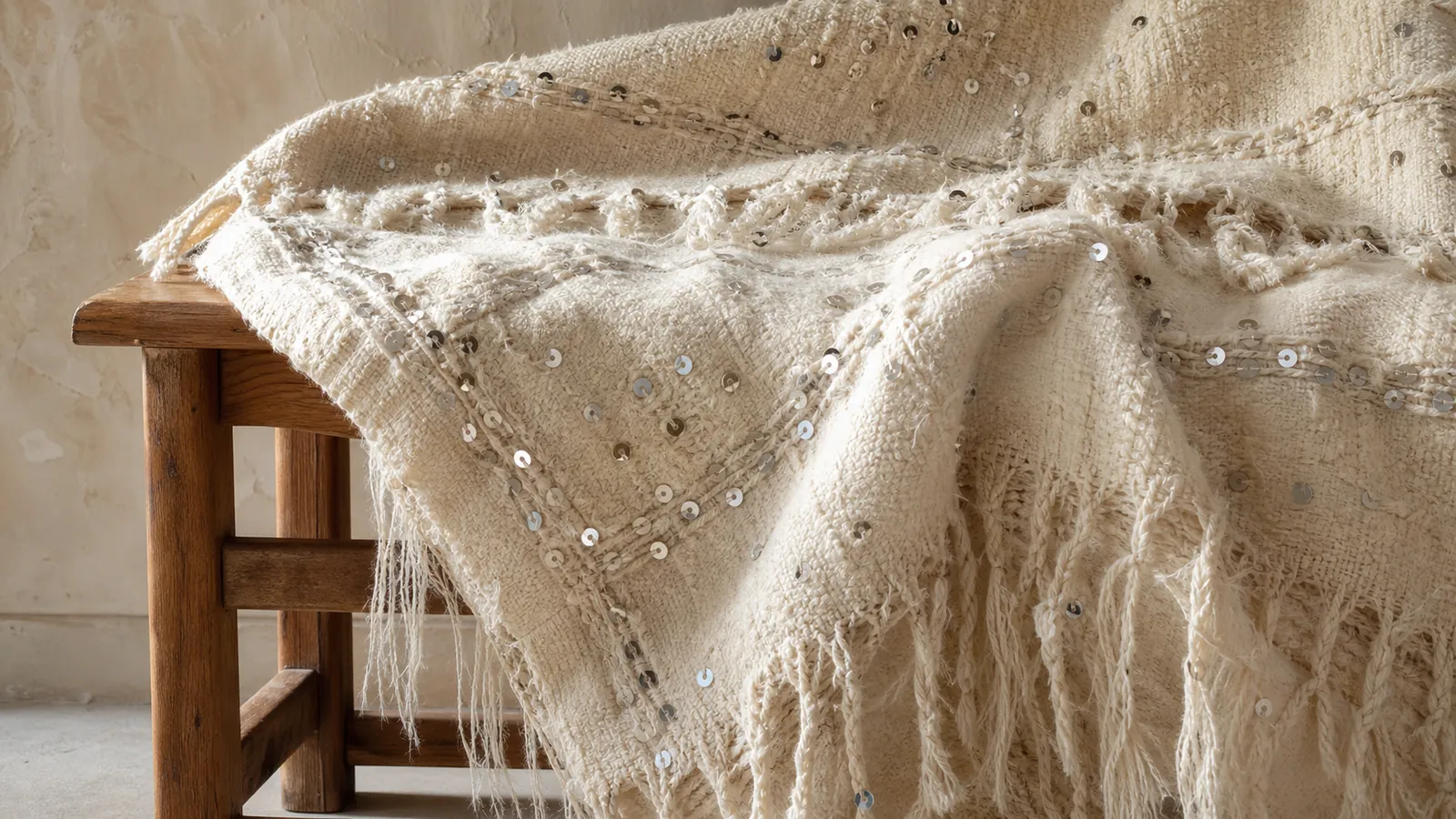
The handira is woven, embroidered, and embellished entirely by hand. Each stage is performed by women, often across different households in the same village. Understanding the process is the fastest way to understand why authentic pieces carry the visual weight that they do.
The foundation of a handira is a flat-woven wool cloth, made on a vertical loom from hand-spun yarn sourced from the family’s own sheep. Unlike pile rugs, the weave is relatively tight and even. The base cloth is usually a single large rectangle — roughly two meters by a meter and a half — woven in the natural color of the wool, typically ivory or cream. This flat cloth becomes the canvas for everything that follows.
Once the base cloth is complete, the weaver (or, more commonly, the weaver together with female relatives) embroiders symbolic motifs across the field. The embroidery thread is usually dark wool — brown, black, or deep indigo — but red, orange, and saffron also appear. The motifs follow the Berber visual vocabulary shared across all Moroccan textile traditions: diamonds for fertility, zigzags for water and time, crosses for protection, chevrons for movement, combs for womanhood. On a handira, these symbols are often organized into horizontal bands across the blanket, reading like stanzas of a poem.
This is the step that makes the handira unmistakable. Hundreds — sometimes thousands — of small metallic sequins are sewn by hand into the base cloth, typically in rows, clusters, or geometric arrangements that echo and extend the embroidered symbols. The sequins are usually flat, round discs of tin-plated metal or brass, with a single hole at the center. Each one is sewn on individually with a fine thread.
The sequins serve both a practical and a symbolic purpose. Practically, they catch light dramatically when the bride walks under sun or candlelight — a visual effect that distinguishes the wedding blanket from all other textiles the bride would wear. Symbolically, the flashing metal is believed to deflect the evil eye and misfortune, turning the blanket into a portable protective shield.
When the handira is complete, it is washed once in cold stream water to settle the fibers, dried in indirect sunlight, and often ritually blessed by the women of the family before being folded and stored until the wedding. In traditional households, the blanket is not worn casually or displayed publicly in the weeks before the ceremony — its first public appearance is the wedding itself.
The embroidered motifs on a handira follow the same symbolic vocabulary found on Beni Ourain, Azilal, and other Moroccan textiles, but they are organized with particular intensity because of the blanket’s ceremonial role. A handira is, among other things, a protection. Every symbol contributes.
A bride who wears her handira on her wedding day is not simply wearing a beautiful object. She is wearing a compressed visual prayer, written in her family’s hand, for the life she is about to begin.
Although the core tradition is consistent, there are regional and stylistic variations to be aware of:
As handira blankets have become collectible, imitations have appeared — machine-made versions, synthetic copies, and blankets constructed from inferior materials that imitate the look. A few reliable tests separate the real from the costume:
Both are collectible, but for different reasons.
Vintage handiras — pieces made between roughly 1940 and 1990 — carry the marks of actual use in actual weddings. The wool has softened, the sequins may show patina, and the blanket often bears small repairs where decades of use have required mending. These pieces are irreplaceable because they document real ceremonies. Prices for strong vintage handiras typically range from €600 for smaller pieces to €3,000 or more for large, well-preserved Zemmour examples.
Contemporary handiras are still being woven by active weavers in the Middle Atlas, sometimes for weddings, sometimes for the market. These newer pieces offer brighter sequins, less wear, and often larger sizes. They lack the documentary quality of vintage work but represent the continuation of the living tradition — and by buying them, you directly support the weavers keeping the craft alive. Prices for contemporary handiras range from €300 for smaller decorative versions to €1,500 for full-size traditional pieces.
Although the handira was originally made as a cloak, most homes outside of Morocco use it in other ways. A few reliable placements from years of client work:
This is by far the most common contemporary use. The sequins catch light beautifully against a white wall, and the blanket’s size — usually around two meters tall — works naturally as a textile artwork above a sofa, bed, or dining table. Hang from a simple flat wooden dowel threaded through a hand-sewn top sleeve, or use discreet fabric tabs. Never nail or staple directly into the blanket.
A handira draped over the back or arm of a neutral sofa transforms the piece of furniture instantly. The sequin work catches evening light as lamps turn on. For this use, choose a handira with slightly less dense sequin coverage so that guests can sit comfortably nearby without catching clothing.
Placed across the foot of a bed, a handira adds texture, weight, and a visible handmade presence. Some owners use it as a full bedspread on special occasions. Daily use is possible but accelerates wear of the sequins — consider a lighter handira for regular use and reserve denser vintage pieces for display.
A handira folded on a wooden bench at the foot of a bed, on top of a cedar chest, or on an ottoman reads as a display object — the folded blanket shows its edges, its embroidery, and a portion of its sequin work without requiring hanging hardware.
Handira care follows the general rules for Moroccan wool textiles, with important adjustments for the sequins.
Many vintage handiras on the international market were acquired from rural families whose economic circumstances made selling the blanket unavoidable. A handira is, in its original context, an object of deep family meaning — not a commodity. The most ethical way to buy a handira is to buy from a source that can document where the piece came from, that has compensated the selling family fairly, and that understands the cultural weight of what it is passing into your hands.
Contemporary pieces are simpler ethically: buying directly from women’s cooperatives in the Middle Atlas supports the weavers who continue the tradition and ensures that the next generation has an economic reason to learn the craft. At Tigemi, every handira in our collection is either sourced from documented estates with family permission or commissioned directly from named weaving cooperatives in the Zemmour and surrounding regions.
Yes, in contemporary usage. Internationally, handira almost exclusively refers to the sequined Berber wedding blanket. In Morocco, the word can also mean other thick wool coverings, but most sellers and buyers now use handira specifically for the wedding version.
Authentic contemporary handiras range from around €300 for smaller decorative pieces to €1,500 for full-size traditional examples. Vintage handiras with documented provenance typically range from €600 to €3,000, with exceptional pieces from the Zemmour region sometimes selling for significantly more.
Traditionally, yes — the blanket was designed to be worn as a ceremonial cloak. In practice, most handiras acquired today are used as display textiles rather than garments because of their weight and the fragility of the sequin work under friction. If you wish to wear one, choose a sturdy contemporary piece rather than a delicate vintage one.
Some patina on tin-plated or brass sequins is normal, especially on vintage pieces, and many collectors consider it part of the blanket’s character. Aggressive polishing can damage the thread attachments. If tarnish is extensive, a specialist textile conservator can advise on safe treatment.
Only briefly, for airing. Prolonged outdoor use exposes the wool to UV fading and the sequins to accelerated tarnishing. Handira blankets are interior textiles. For outdoor use, consider a simpler Berber wool throw without embellishment.
Of all the textiles Morocco has given the world, the handira is the most intimate. A Beni Ourain covers a floor. An Azilal decorates a wall. A Boucherouite plays in a corner of a room. A handira, in its original life, touched a single woman on the single most important day of her adult life — and it was made, by the women who loved her, specifically for that moment.
When you bring a handira into your home, you are not acquiring a decorative object. You are accepting the custody of a ceremony. The bride who wore this blanket, or the one who will wear its contemporary cousin, was carried into her new life under its weight. Every sequin was stitched by a woman who loved another woman. Every symbol was an argument for protection, for fertility, for a life that would continue.
That is what a handira carries. That is what you are welcoming when you hang one on your wall or fold one on your bed. And that is why, once you have lived with one, you begin to understand why the women of the Middle Atlas have been making them for a thousand years.
The thousands of small tin-plated or brass sequins serve two purposes. Practically, they flash dramatically as the bride walks under sun or candlelight. Symbolically, the flashing metal is believed to deflect the evil eye and misfortune – turning the blanket into a portable shield of protection.
A handira is the sequined Berber wedding blanket. A tamizart is its close relation without sequins – a wool blanket woven for daily wear. Because the two can look similar at a glance, less careful dealers sometimes sell a tamizart as a handira, so the distinction matters if authenticity is important to you.
Most owners hang them. The sequins catch light beautifully against a plain wall, and the blanket’s height works naturally as textile art above a sofa or bed. Use a flat wooden dowel through a sewn sleeve or discreet fabric tabs – never nail or staple into the wool.
Roll it, never fold it – folding presses permanent creases and crushes sequins unevenly. Roll with the sequin side facing inward, wrap in cotton muslin, and tuck in a few cedar sachets. Air it outdoors in indirect sunlight twice a year.
A handira on the wall sets the tone for a whole room; the sofa beneath it is where you complete the story. Pair the blanket’s ceremonial ivory-and-metal glow with a handwoven Sabra silk pillow or two – the cactus silk’s cool sheen quietly answers the sequins’ flash. Explore our one-of-one Sabra silk pillows, each handwoven in Morocco, $99, with free worldwide shipping.