FREE U.S. SHIPPING · DHL EXPRESS DELIVERY
ARTISAN-MADE IN MOROCCO · LIMITED COLLECTIONS
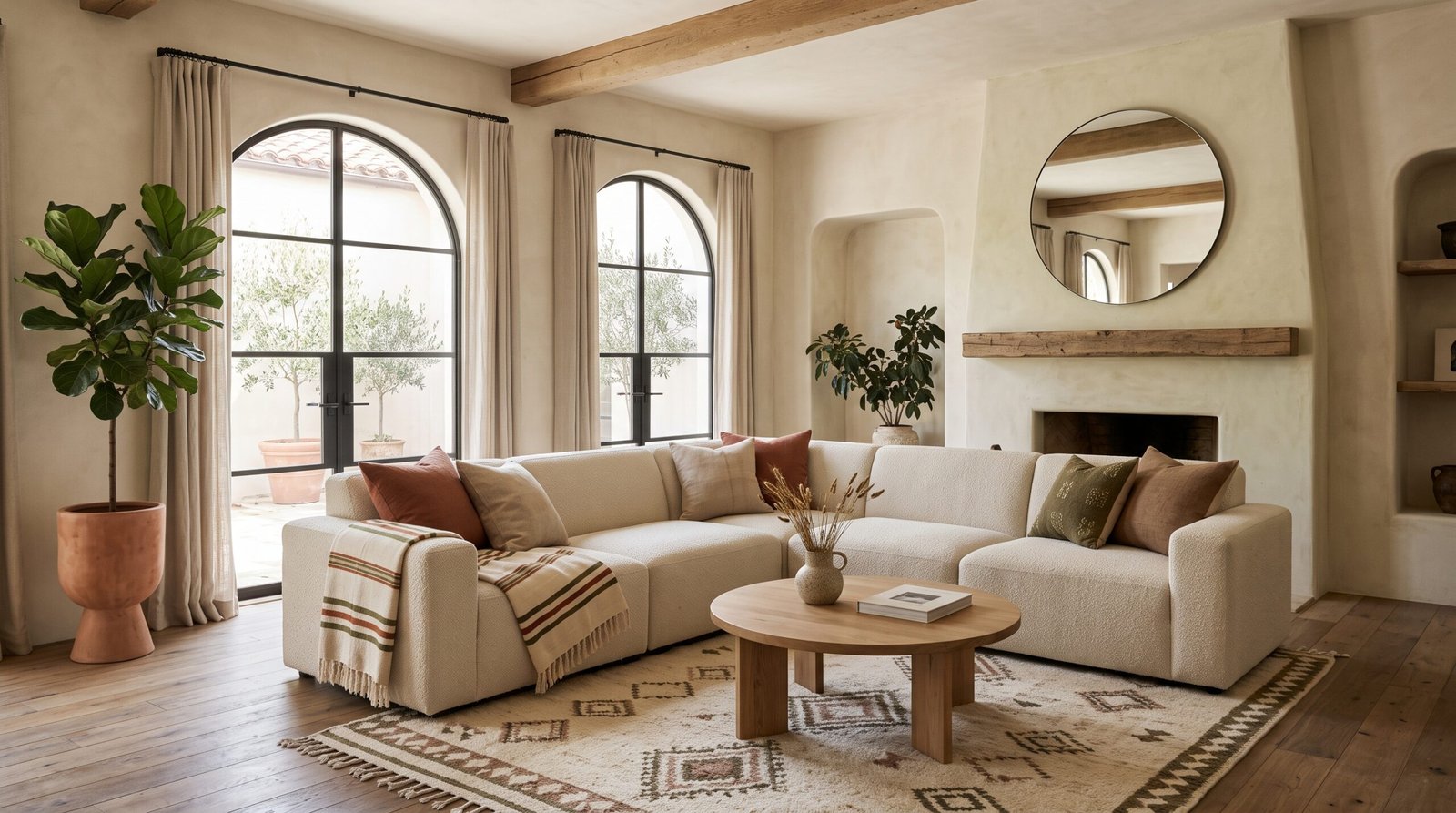
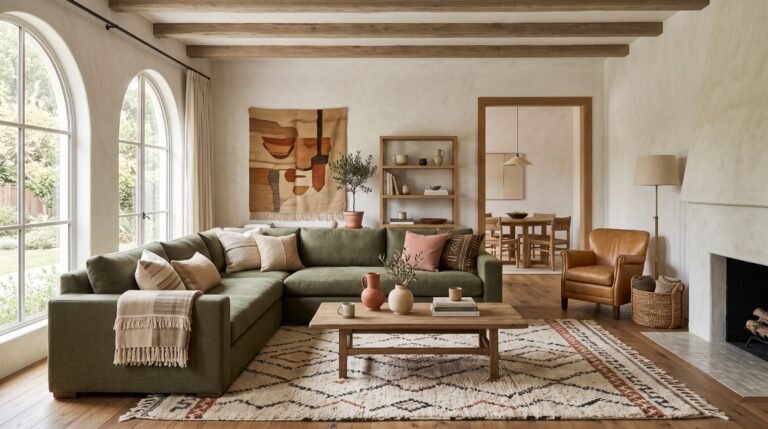
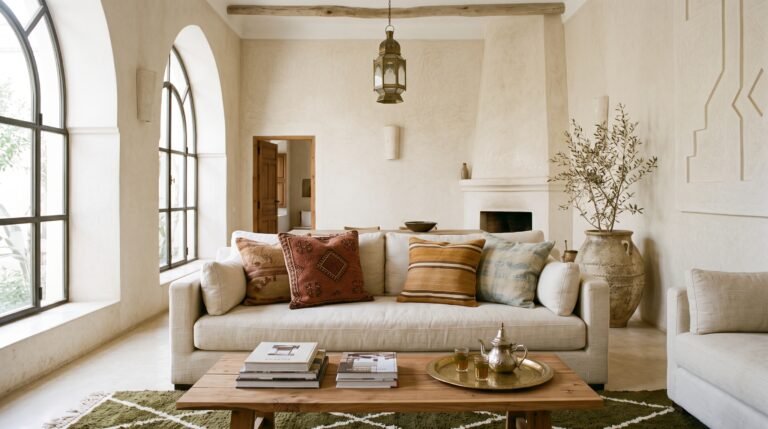
Learn how one distinctive textile can bring texture, contrast and personality to a cream-and-wood living room—without crowding the calm neutral foundation.
A cream sofa, warm wood coffee table, pale rug and a few neutral accessories should create an inviting room. Yet the result can still feel flat, unfinished or too close to a showroom display. The instinctive response is often to buy more home decor: another vase, another throw, or a complete set of cushions. That usually adds volume without adding character.
Before buying anything, make one decision: does the room need more objects, or does it need a clearer focal point? In most warm neutral rooms, the more useful move is to edit what is already there and introduce one concentrated textile treatment. That treatment may be one expressive pillow or a matching pair used together in a single sofa zone. It should add contrast, personality and visual direction without disturbing the calm cream-and-wood foundation.
This approach works particularly well for renters, small rooms and anyone keeping an existing sofa. It also provides a disciplined way to use character-rich textiles, including Moroccan throw pillows, without turning a minimalist interior into a crowded collection.
A room does not necessarily feel generic because it lacks color. More often, too many of its elements behave in the same way. The sofa, rug, table and accessories may be attractive individually, but together they offer too little contrast.
Assess the room across five dimensions:
You may find that several dimensions feel too similar. A neutral cushion placed on a neutral sofa, for example, may add softness but contribute no meaningful change in surface, color, shape or personal significance. The answer is not necessarily more cushions. It is one element that performs a clear visual role.
The rule is simple: preserve the quiet foundation and create one concentrated textile treatment.
“One treatment” can mean a single character pillow or a matching pair positioned together. A pair counts as one treatment only when both pieces share the same design and occupy the same sofa zone. Two unrelated statement pillows placed at opposite ends of a sectional create two focal points and weaken the sense of restraint.
The focal textile should do work that the surrounding room is not doing. It might introduce an irregular pattern, a richer color, a softer edge or a different degree of sheen. If documentation for the specific piece confirms handweaving, embroidery or another form of handwork, those characteristics may also provide contrast with uniform upholstery. Do not assume those details from the “Sabra” name alone.
A one-of-a-kind Moroccan Sabra pillow from Tigemi can be considered for this role because a singular piece avoids the appearance of a generic coordinated set. However, its suitability depends on the documented details of that individual item: its actual fiber content, construction, origin, colors, condition and dimensions. Treat the product photograph and label as the starting point for a decision, not the category name as proof of how it was made.
Stand in the room during daylight and identify the undertone of the two largest elements: the sofa and the wood. Cream upholstery may lean toward ivory, oatmeal, beige or cool gray. Wood may appear honeyed, red, chocolate brown, pale yellow or gray.
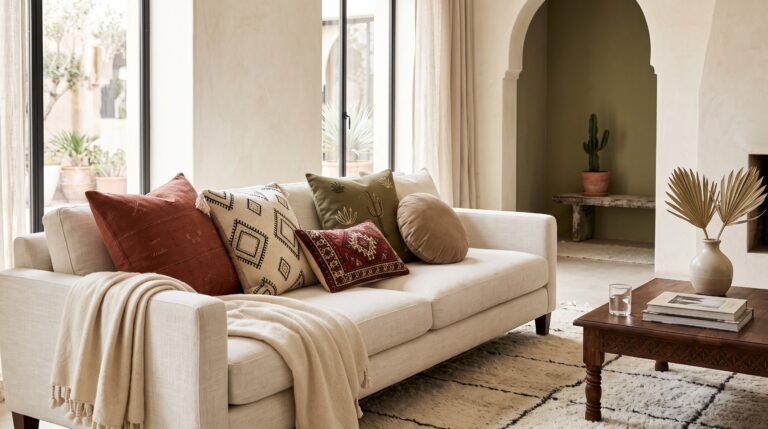
The focal textile does not need to match either material, but it should relate to their temperature. Rust, ochre, muted red and warm green often sit comfortably beside ivory upholstery and honey-toned wood. A cooler room may respond better to dusty blue, charcoal, blue-green or a cooler burgundy.
This is not a fixed color formula. Light changes how undertones appear, and nearby flooring or wall color may affect the result. Compare the textile with the sofa in the actual room whenever possible rather than judging it against an isolated online image.
Once the temperature feels compatible, look for difference. Against a pale, matte sofa, consider a textile with stronger pattern definition, a darker value or a subtle change in sheen. Against heavily textured upholstery, a flatter woven surface may provide better contrast than another highly nubby material.
The textile and sofa should not agree on everything. Their controlled disagreement is what makes the arrangement interesting. They simply need one or two visual connections so the combination appears intentional.
A tiny motif may disappear on a large sectional, while an oversized motif can overwhelm a compact loveseat. View the pillow from across the room. If its design becomes a shapeless patch, it may be too small or low-contrast. If it dominates the sofa before you notice anything else, try a quieter pattern, a smaller pillow or a less central position.
A focal pillow still has to function. Check its dimensions against the seat depth and back height. A pillow that is too firm, fragile or large may be moved every time someone sits down, turning a thoughtful arrangement into a daily nuisance. If the textile requires special care, place it where it will not receive constant pressure, food spills or direct contact from pets.
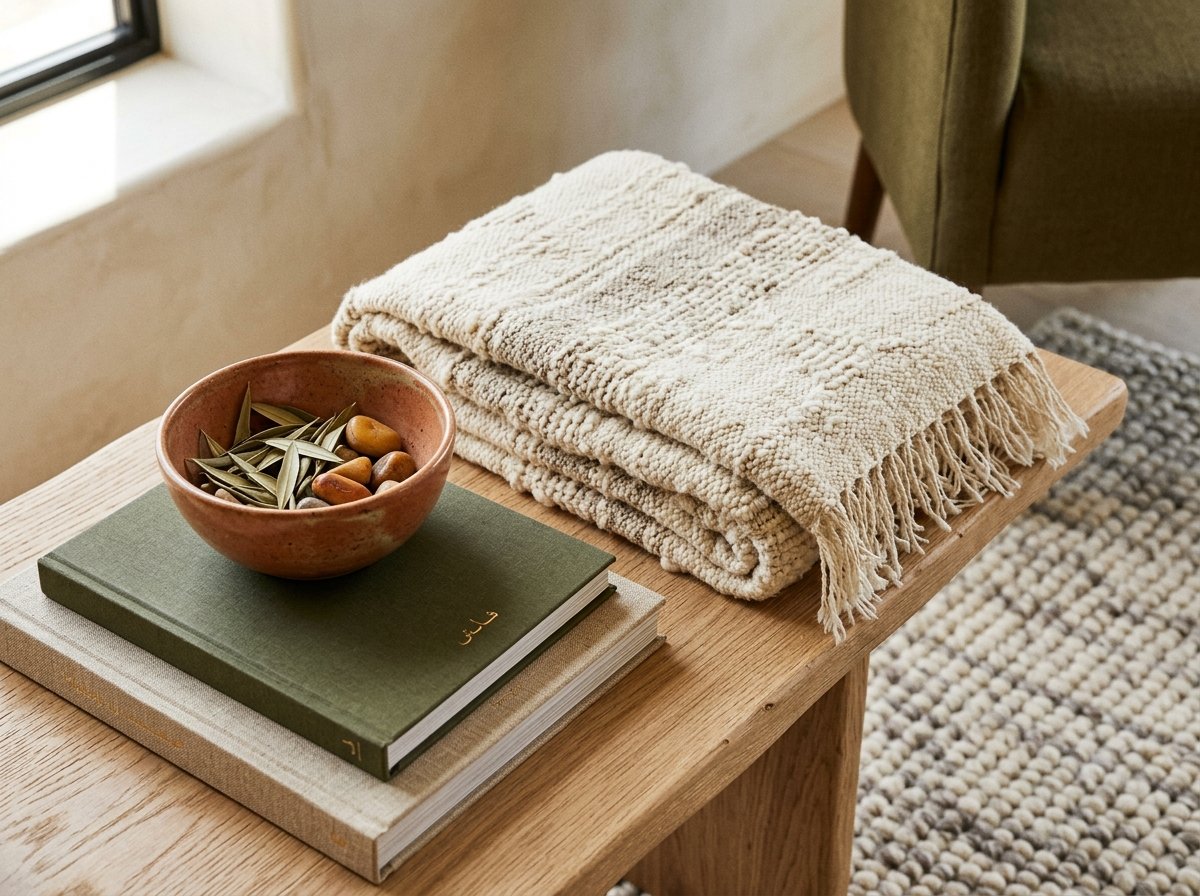
A modern warm minimalist living room can accommodate a strong color or expressive pattern when that interest is contained. The key decision is not simply how bold the textile is, but where the visual activity begins and ends.
Keep the pattern in one sofa zone. On a sectional, that might be the inner corner. On a straight sofa, use one end rather than placing competing accents at both ends. The rest of the cushions should support the upholstery rather than introduce additional themes.
If you are uncertain, remove every decorative pillow and place only the focal textile. Live with that arrangement for a day before adding anything else. You may discover that the sofa needs less throw pillow styling than expected.
For a very bold design, keep nearby surfaces quiet. A patterned pillow, patterned throw, busy rug and crowded coffee table will compete even if their colors coordinate. One strong pattern gains authority when it has neutral space around it.
Place the character pillow at one end, supported by one plain cushion if the sofa needs additional comfort. Leave the opposite end open or use a single neutral cushion that closely relates to the upholstery. This asymmetry feels relaxed while preserving a clear focal point.
The inner corner is the natural anchor because the two sofa sections already direct the eye there. Use one expressive pillow or a matching pair in that corner. Avoid lining every back cushion with decorative pillows; the repetition adds bulk and conceals the clean shape of the sectional.
Use one focal pillow slightly off center. A matched pair may consume too much seating space unless the pillows are small. If the loveseat already has curved arms or distinctive upholstery, select a quieter textile so the features do not compete.
Choose one sofa as the focal side. Do not automatically duplicate the statement pillow on the second sofa. Instead, allow the opposite seating to remain neutral or echo one minor color through a plain cushion. Repetition should connect the seating without making it look like a purchased suite.
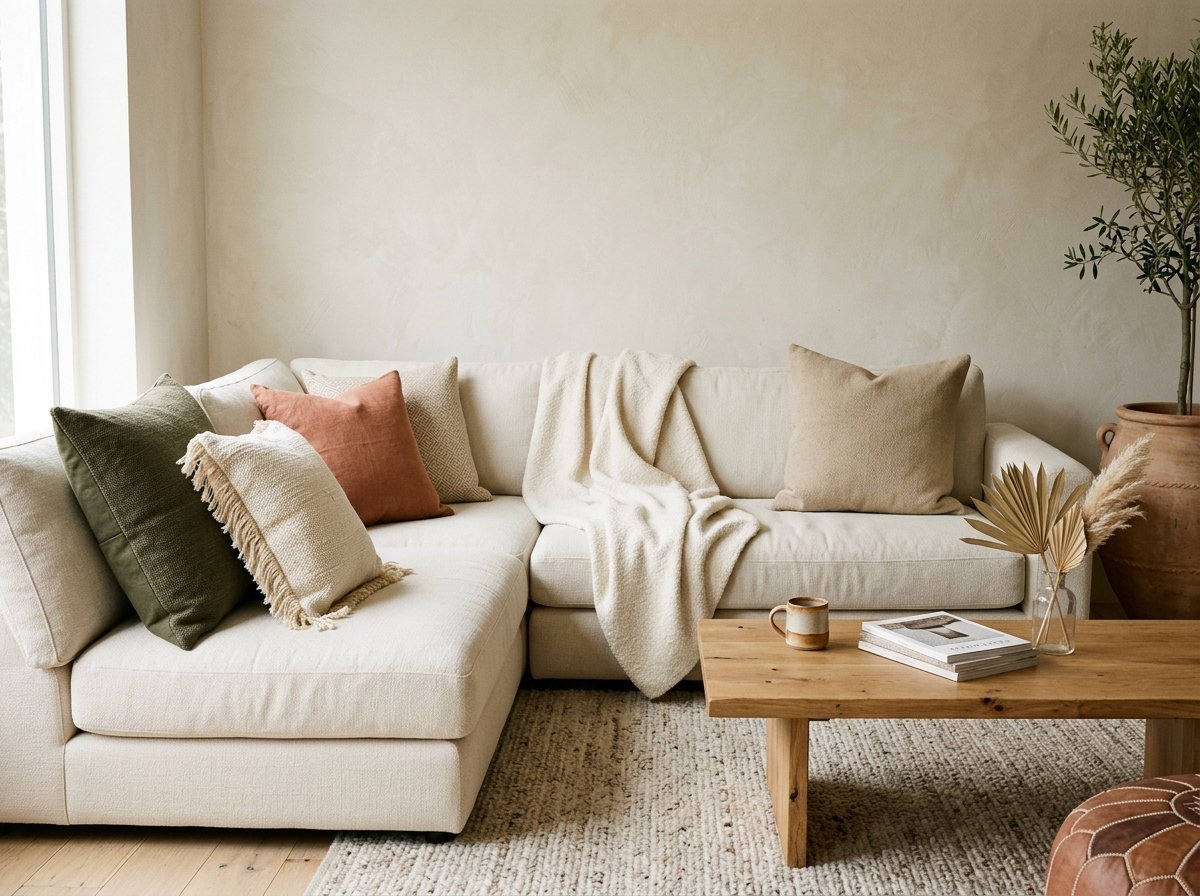
Not every neutral accessory deserves to stay simply because it matches. Consider relocating:
Do not remove personal objects merely because they are imperfect. A worn book, inherited bowl or travel keepsake can make a minimalist room feel specific to its occupants. The aim is not emptiness. It is a visible hierarchy in which every retained object has a purpose, a memory or a useful relationship to the room.
Yes, when the room needs a bridge between the focal textile and its surroundings. Repeat one minor color or material once or twice, but avoid exact matching across an entire pillow collection.
If the focal pillow includes a small rust detail, the echo could be a terracotta vessel on a shelf. If it contains a dark brown line, a wooden frame elsewhere may be enough. A muted metal detail could relate to a lamp base without being identical.
The echo should be quieter than the original. If every repetition has the same saturation and visual weight, the room begins to feel themed. Cohesion comes from a relationship, not duplication.
This method does not require new furniture, wall color or built-in storage. For renters, the most effective changes are portable and reversible:
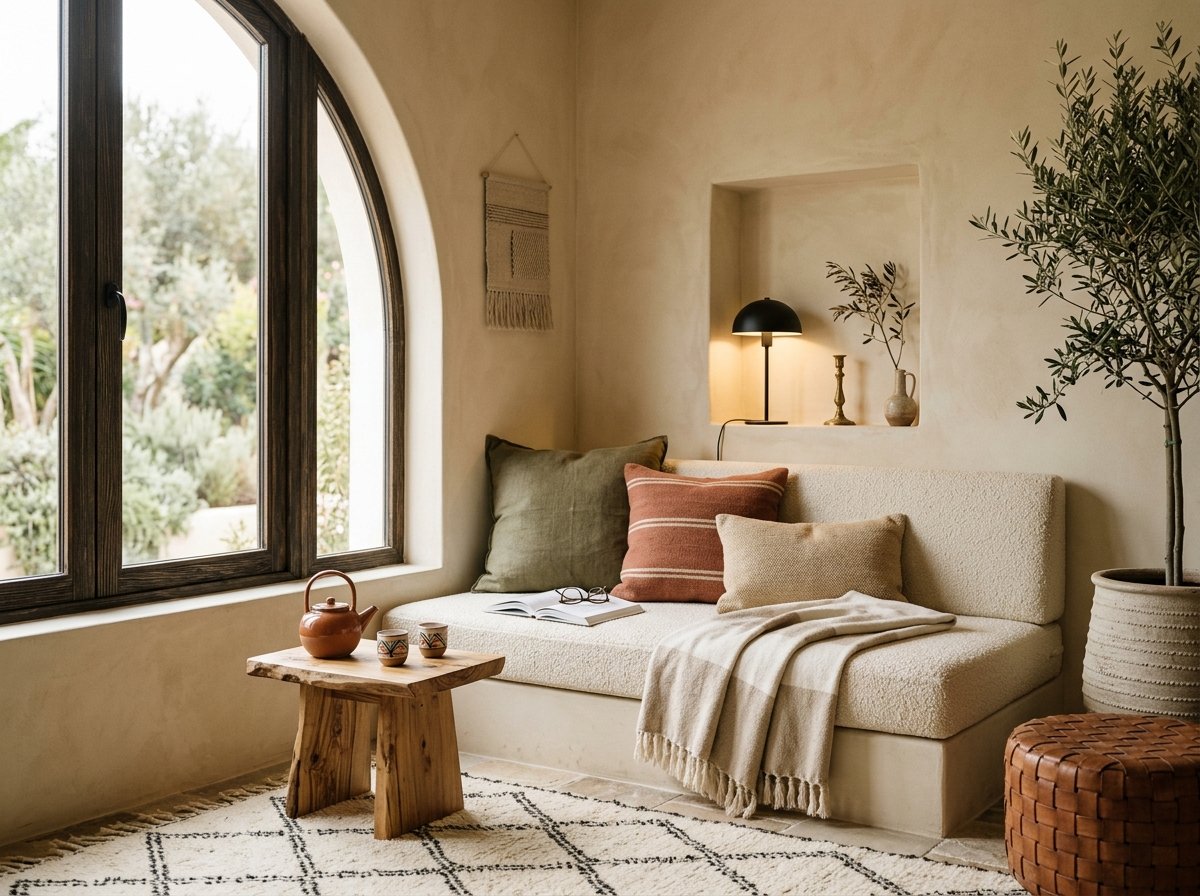
“Sabra silk” and “cactus silk” are marketplace terms that should not be treated as proof of fiber content. Anou, an artisan-owned Moroccan marketplace, published a supply-chain investigation reporting that materials it examined and traced were rayon or acetate rather than fiber extracted from Moroccan cactus plants. That investigation is not a substitute for testing every product, but it creates a clear reason to request documentation instead of relying on broad category descriptions.
For a Moroccan Sabra pillow or any other textile sold in the United States, check:
Describe a pillow as handwoven, embroidered, naturally dyed, cactus-derived or made through a particular cooperative only when documentation for that specific item supports the statement. A product can still be visually compelling without an embellished origin story.
Recent industry reporting suggests that warm materials and expressive interiors are coexisting rather than replacing one another. The National Association of Home Builders highlighted cream, brown, earth tones and warm wood among observed residential design directions. ASID’s 2026 outlook also described renewed interest in boldness, individuality and visible personality.
Designer-market research from 1stDibs reported continued interest in maximalism and eclecticism alongside organic modernism, as well as increased vintage and antique sourcing among surveyed designers. Houzz search analysis similarly identified growing interest in light hardwood living rooms and vintage room styling.
These reports do not create a rule for how an individual home should look. They do, however, help explain why an all-neutral room may now feel more satisfying when it includes one distinctive or storied object. The one-textile rule offers a measured middle ground: warmer and more personal than sterile minimalism, but more restrained than a fully layered maximalist room.
A successful warm minimalist living room does not have to remain anonymous, nor does it need a complete makeover. Keep the cream-and-wood foundation, establish one concentrated point of textile interest, and give that accent enough quiet space to matter. The result is not a room with more decoration. It is a room with clearer choices and a stronger sense of who lives there.