FREE U.S. SHIPPING · DHL EXPRESS DELIVERY
ARTISAN-MADE IN MOROCCO · LIMITED COLLECTIONS
Learn how to coordinate one-of-a-kind Moroccan pillows using the Anchor-Echo-Pause method, visual-weight checks, pattern tests, and comfortable asymmetrical layouts.
Mixing one-of-a-kind Moroccan throw pillows is easier when you stop searching for a matching set and start looking for a visible connection. Choose the pillow you want people to notice first, identify one feature that another pillow can repeat, and add visual quiet only where the arrangement needs it.
Begin with the decision that fits your furniture. An accent chair may need one statement pillow. A loveseat may work best with two different pillows connected by color or value. A larger sofa pillow arrangement can support three or five pillows, but only if the focal point remains clear and the furniture stays comfortable to use.
This guide uses an Anchor-Echo-Pause framework for practical throw pillow styling. It is an editing method rather than a rigid formula, so it works with pillows you already own as well as singular pieces that cannot be purchased as identical pairs.
Product note: Tigemi markets one-of-a-kind throw pillows described as Moroccan Sabra silk. Fiber content, geographic origin, maker, dye, production method, care requirements, and related claims should be confirmed for each item before purchase or publication.
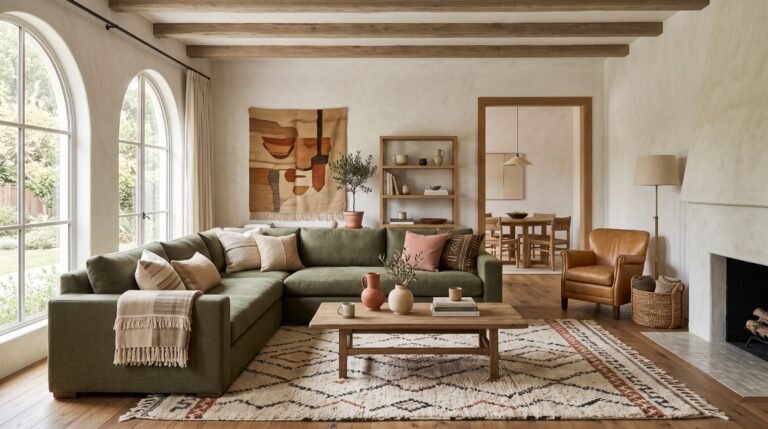
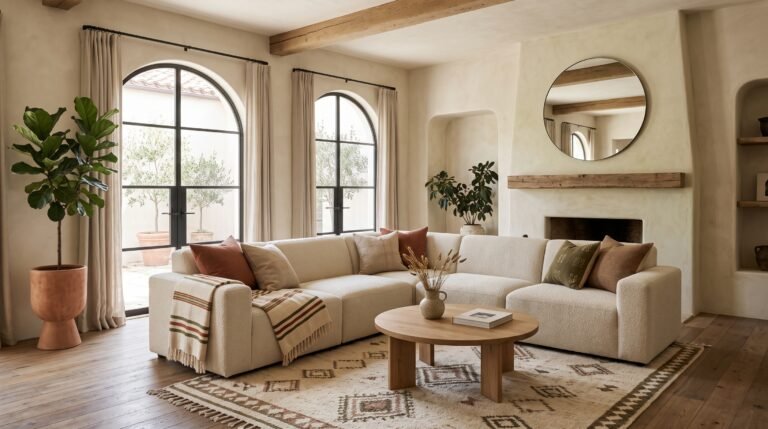
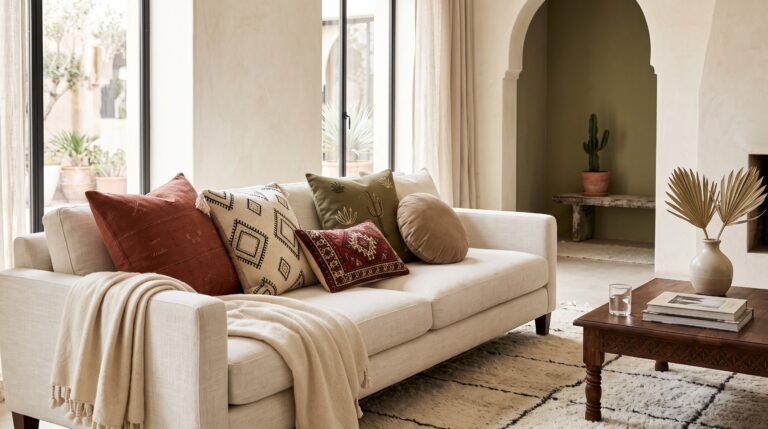
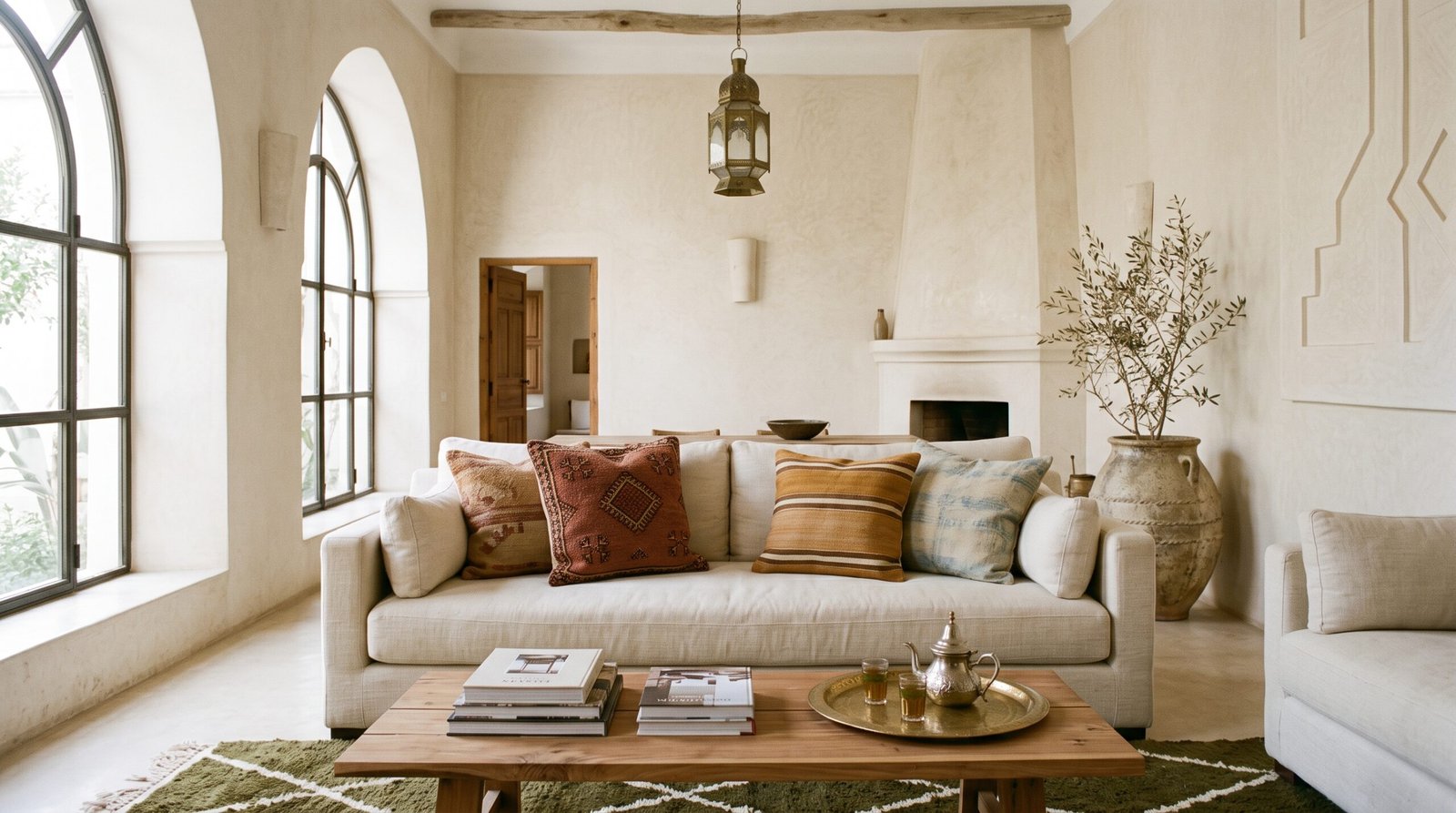
Editorial image disclosure: The illustrations supplied for this article are AI-generated. They are not photographs of available Tigemi products and do not verify the materials, construction, origin, maker, color, or availability of any textile. If the complete-room illustration is used as the WordPress featured image, it should not be repeated as the first inline image.
Give each pillow a role before deciding where it should sit. This prevents a collection of individually appealing pillows from becoming a visually confusing group.
You do not need all three roles in every arrangement. On a chair, quiet upholstery may provide the pause. In a two-pillow combination, the second pillow can echo a secondary color while remaining restrained enough to provide visual rest. On a larger sofa, a plain cushion you already own may be the only supporting piece you need.
The framework is especially useful for one-of-a-kind throw pillows. Instead of trying to reproduce a set, you create coordination through characteristics that can be seen and compared. The finished arrangement can feel collected and intentional without suggesting that the textiles were made as exact companions.
When pairing two unique pillows, finish this sentence: “These belong together because they share…” If the answer is clear, the combination probably has enough continuity. One strong connection is usually more useful than several vague similarities.
Be cautious with near-matches. Two colors that are almost identical but have conflicting undertones may look accidental. Two patterns with nearly the same scale can merge into a single restless area. When a pairing feels “close but not right,” try making the difference more obvious rather than searching for a better match.
You can separate near-matching pillows with a quiet cushion, change the size or shape of one piece, or select an echo pillow with a more distinct value. Clear contrast often looks more deliberate than an unsuccessful imitation of a matching set.
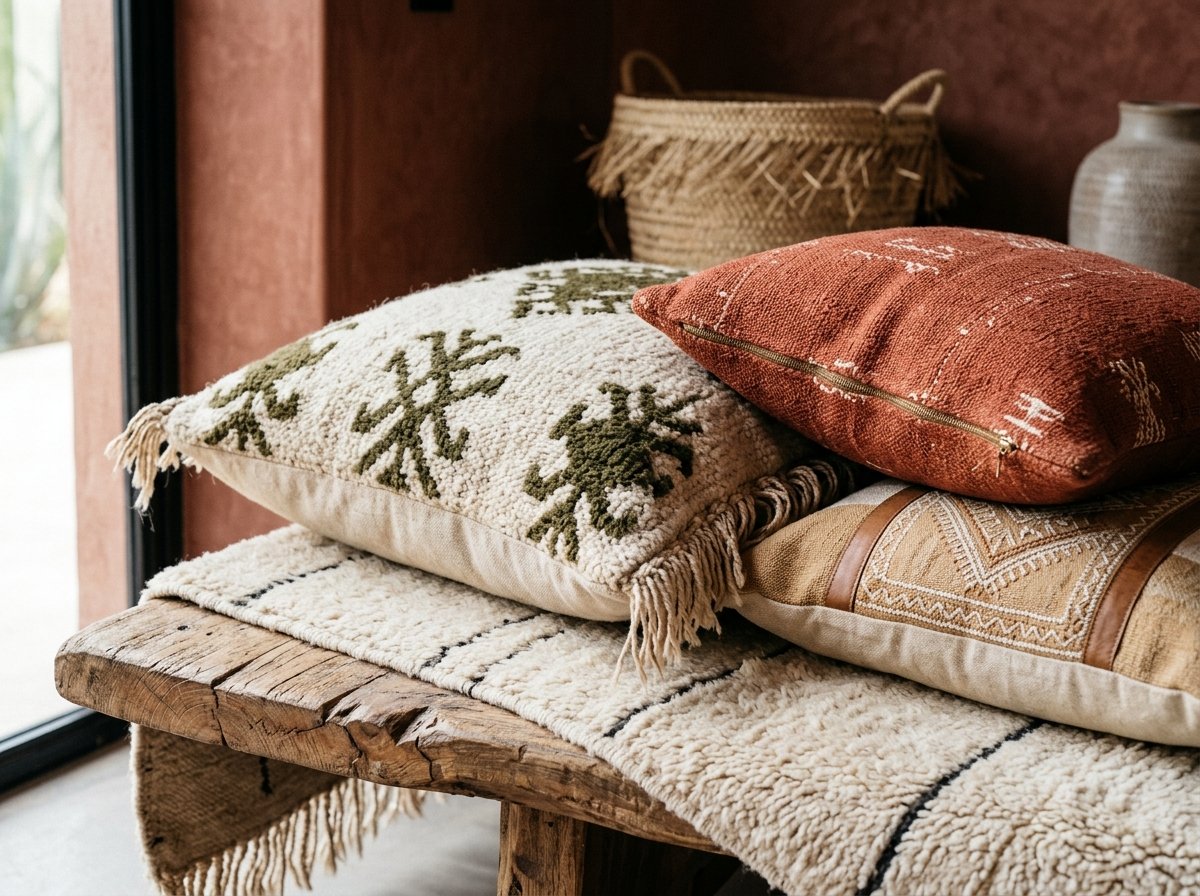
Visual weight describes how strongly an object attracts attention. Size contributes to visual weight, but a small high-contrast pillow may appear more prominent than a larger, quieter cushion. Compare four observable factors:
If one side of the sofa feels visually heavy, you do not have to copy it at the other end. Add a smaller counterweight, place a pause cushion beside the anchor, or make the opposite cluster quieter. An asymmetrical pillow arrangement feels balanced when attention is distributed thoughtfully, not when both sides contain identical objects.
Photograph the proposed pillows together on the furniture and view the image in grayscale. Without color, it becomes easier to compare light-and-dark relationships. If one pillow turns into an obvious dark or light block, decide whether that emphasis supports the intended focal point.
Next, compare motif density. Look at the size, spacing, and frequency of the marks. Two pillows may have similar values but still compete because both contain tightly packed, high-contrast patterns.
Return to the color image for the second test. Compare undertones with the sofa, rug, curtains, and nearby artwork. The colors do not need to match exactly, but their relationship should look intentional. If the combination seems slightly wrong, test a clearer contrast before rejecting either pillow.
Two patterned pillows can sit together successfully when they have both a connection and a distinction. The connection gives the eye a reason to group them; the distinction allows each design to remain readable.
Ask these questions before committing to a pairing:
Test the pillows in three positions: touching, separated by a solid cushion, and placed at opposite ends of the sofa. A pairing that competes when touching may work well when divided into separate clusters.
If the room still feels busy, remove one active pattern from the immediate area. Change only one variable at a time. That makes it easier to identify whether the problem is color, density, scale, placement, or simply too many focal points.
One Moroccan throw pillow can be enough when the furniture is compact, the surrounding room already has several patterns, or the pillow has sufficient visual presence to stand alone. This approach works especially well on an accent chair, bench, small loveseat, or restrained sofa.
If the pillow looks isolated, add one quiet cushion that repeats its background value or a secondary color. Do not add more pillows merely to reach a predetermined count.
Decide whether one pillow should lead or whether both should carry similar emphasis. If one has greater visual weight, make it the anchor and name the attribute echoed by the second.
If both are highly patterned, test them side by side, separated by a solid, and at opposite ends of the furniture. The best position may depend on the sofa more than on the pillows themselves.
Start with one anchor, one echo, and one pause. Place the largest or quietest cushion toward the back, then keep the anchor visible rather than burying it behind the other pieces.
On a compact sofa, group all three near one arm and leave the remaining seat open. On a wider sofa, a two-and-one arrangement can distribute visual weight without creating formal symmetry.
Divide five pillows into uneven clusters, such as three at one end and two at the other. Give one cluster the dominant anchor and keep the opposite group comparatively quiet. Repeat a color role, overall value, texture, or pillow shape across the two groups to create continuity.
Five pillows are not automatically better than three. Use the larger arrangement only when the seat is deep and wide enough to remain functional.
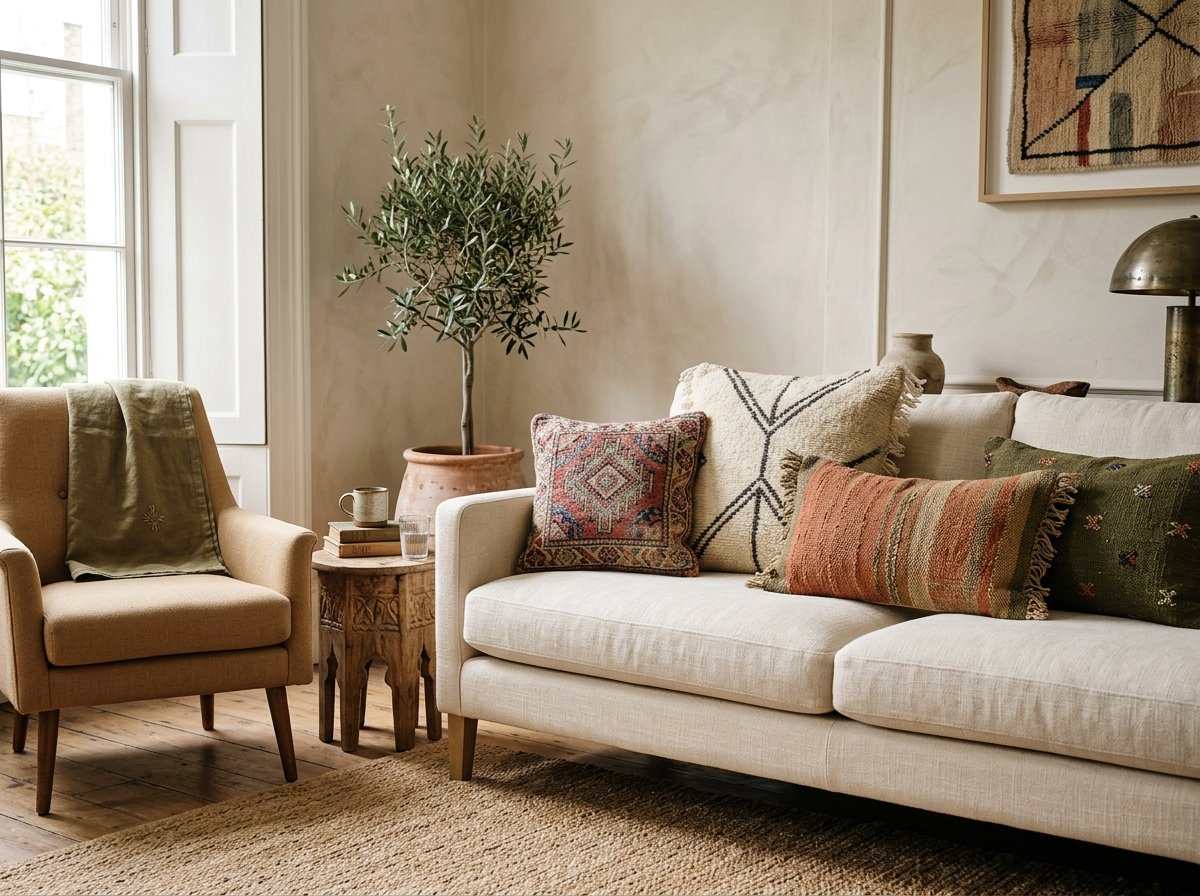
Use one pillow against the back or angle it into a corner. Sit in the chair before finalizing the placement. The pillow should not cover most of the back, remove too much seat depth, or push the sitter forward.
For two pillows, place one in each corner and leave the center open. For three, group the anchor and echo near one arm and place the quieter cushion at the other. Avoid filling the middle if two people regularly share the seat.
Try a three-pillow cluster weighted toward one arm, or divide five pillows into groups of three and two. If the room needs more order, use symmetrical placement with nonmatching pillows connected through size, value, shape, or color intensity.
Begin at the inside corner, where pillows may provide useful back support, and work outward. Keep most of the chaise open if it is regularly used for reclining. Available back space is not an obligation to fill every section.
Complete a sit test in every usable position. If people must relocate several pillows before sitting down, reduce the number or move the most decorative piece to a nearby chair or bench.
A distinctive pillow does not require a complete room redesign. Cushions you already own can serve as the echo or pause:
Coordinate pillows with a rug or artwork by repeating the role of a color rather than copying an exact motif. A rust tone used as a minor rug accent might become the dominant sofa color. A blue that occupies much of a painting might appear only as a small pillow detail.
Compare visual activity as well as color. A dense, high-contrast rug may benefit from pillows with open motifs or quiet backgrounds. A restrained rug leaves more room for active Moroccan pillow combinations. The goal is continuity across the room, not literal duplication.
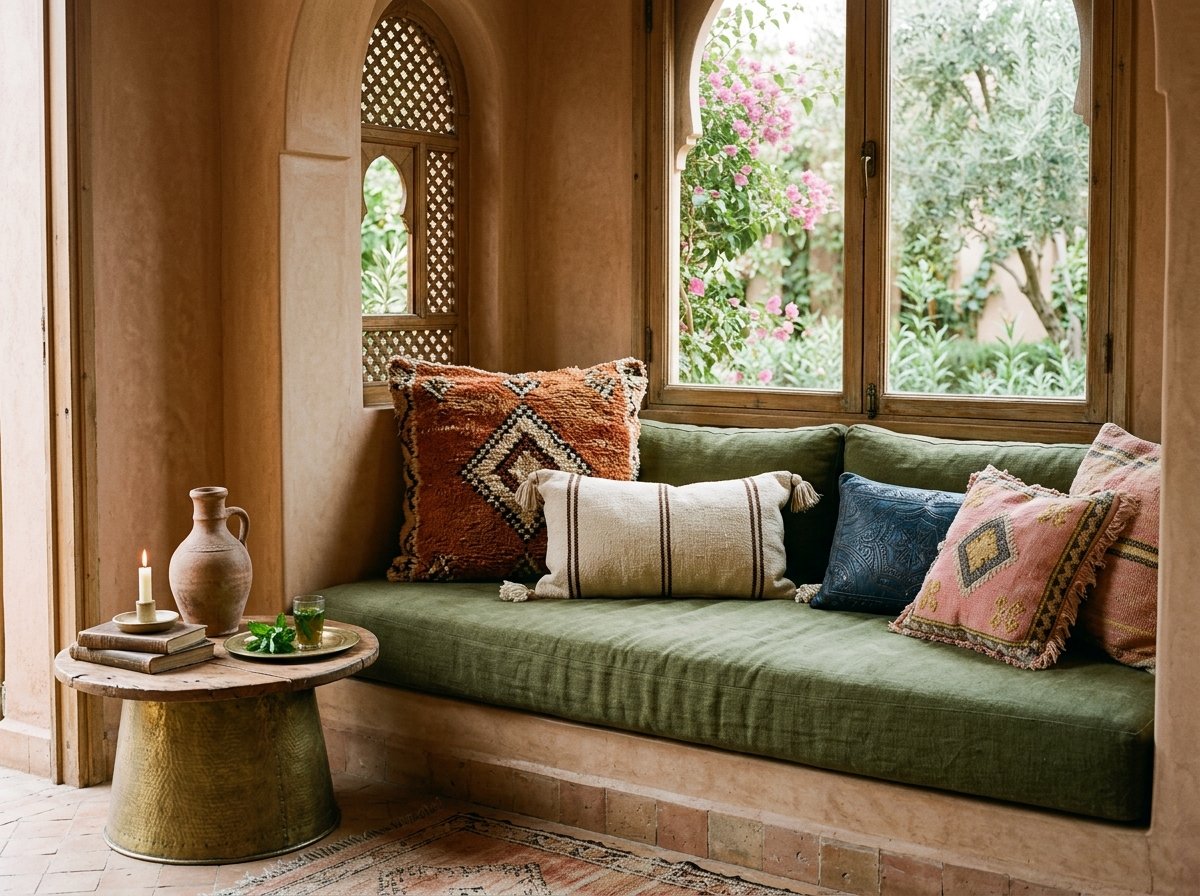
Terms such as Moroccan throw pillows, Sabra silk pillows, and “cactus silk” may be used as seller categories or styling descriptions. Those terms alone do not verify the fiber content, geographic origin, production method, maker, dye, age, sustainability, motif meaning, or care requirements of an individual item.
An artisan-centered investigation published by Anou in 2018 reported extensive use of rayon-based yarn in products marketed as Sabra or cactus silk. That report does not establish the composition of every pillow sold under those names. It does demonstrate why the category name should not replace item-level documentation.
Before relying on a listing or repeating its claims, look for information addressing:
The Metropolitan Museum of Art records an early nineteenth-century embroidered silk-and-cotton cushion-cover border attributed to Fez, Morocco. That collection record illustrates the value of documenting material, technique, date, and geography separately. It does not establish the origin, material, age, or meaning of designs found on contemporary products.
Verification required: Tigemi markets one-of-a-kind throw pillows described as Moroccan Sabra silk. Any statement about a specific item’s fiber, origin, maker, dye, production method, care, sustainability, age, or cultural meaning should be supported by item-level records before it appears in editorial or product copy. Neither an illustration nor visual inspection can provide that documentation.