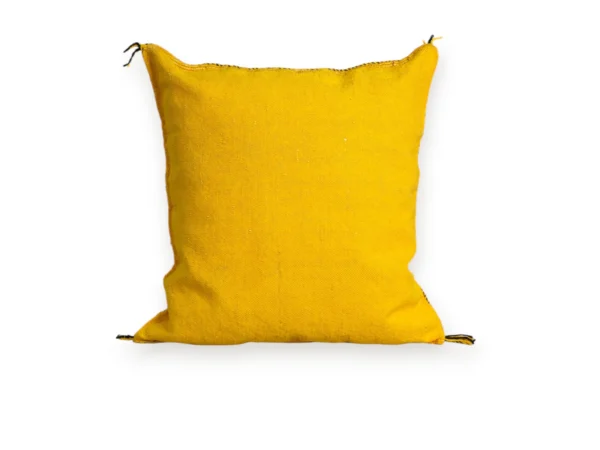
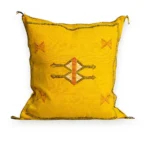
Woven on low-warp looms in the foothills of the Anti-Atlas, this saffron cushion holds the color of the hour before dusk — when the stone walls of Tazenakht turn gold and the valley softens into honey. The yellow is turmeric drying on flat rooftops, the sun pressed into wool and silk, a quiet warmth kept inside a weaver’s hands.
One of only two ever woven. Never to be remade.
A Saffron Piece, Not a Decorative One
South of the Atlas, where the red earth turns to ochre and the wind thins over the argan trees, there is a slower kind of weaving. The women of Tazenakht cut long leaves from the agave cactus, beat them against river stones, comb the fibers clean, and spin what remains into sabra silk — a thread that holds light the way water holds it. The yellow comes from turmeric and saffron boiled in copper pots; the indigo from fermented leaves; the red ochre stars from madder root pulled in late spring. This pillow began there: in ochre dust, in agave leaves, in the patient pull of a shuttle, in a voice humming across the loom.
The Language of the Motifs
In Amazigh weaving, every symbol is a sentence.
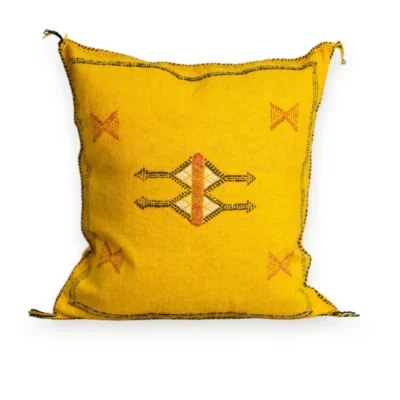
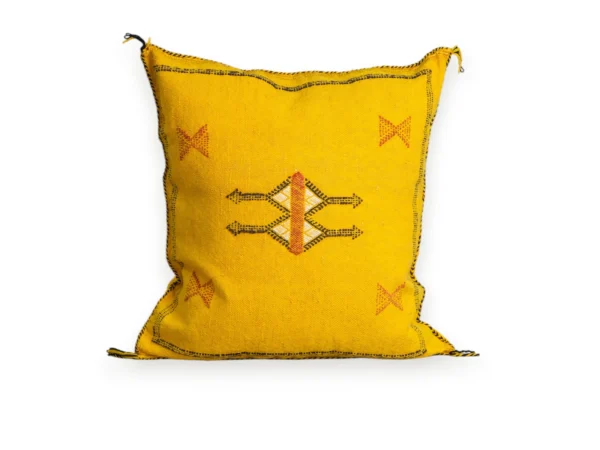
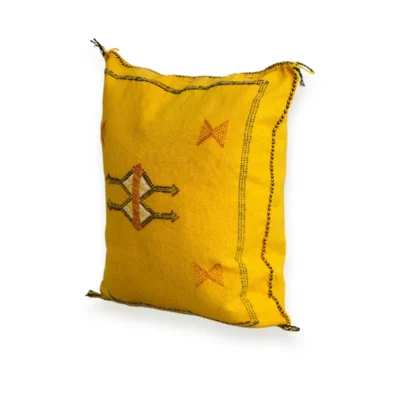
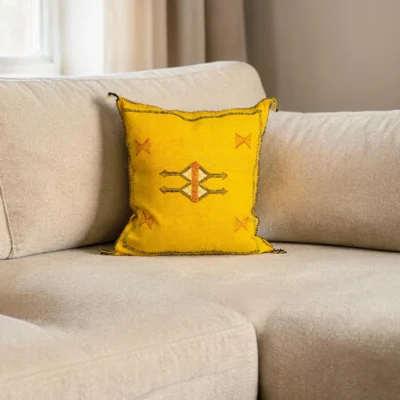
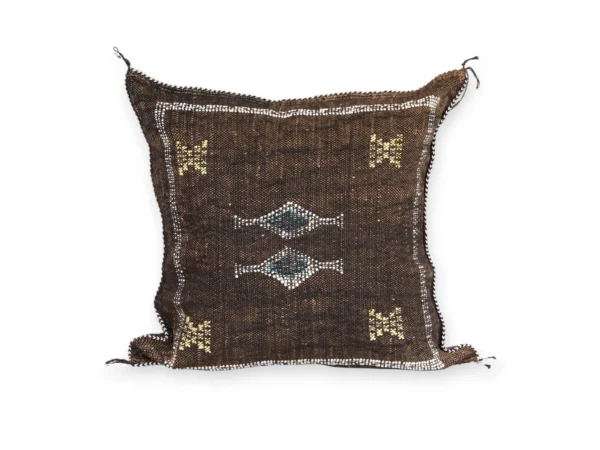
The central sun medallion, stitched in indigo with a heart of ivory and ochre, is the memory of the caravan — the long desert road that runs oasis to oasis, written here in dots, dashes, and outstretched arms. It is the piece that gives the pillow its name: a small sun resting on the horizon of the weave.
The four corner stars, worked in red ochre, are the four cardinal directions — the weaver’s blessing spoken to each wall of the home, so that whoever sits beside this pillow sits inside that blessing.
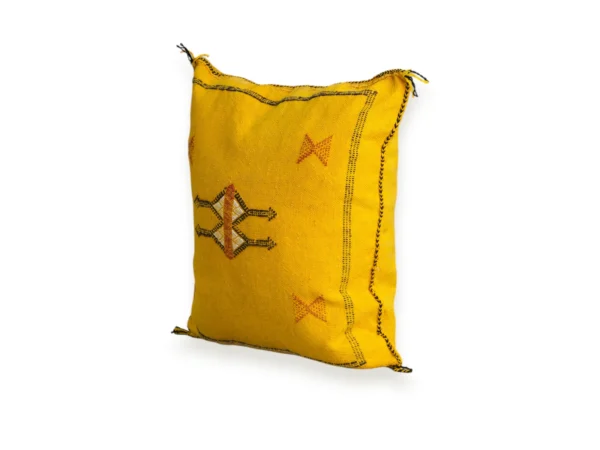
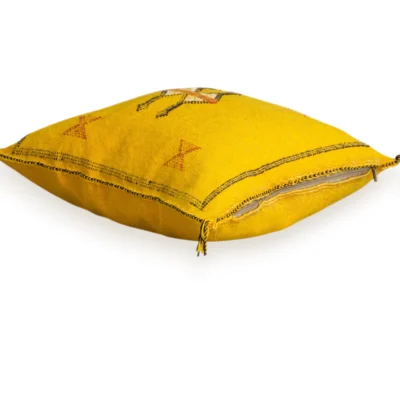
The twisted cord and small tassels along the edges are the signature of Tazenakht’s most careful hands — a finishing detail added only when the work is unhurried, only when the weaver has time to braid a margin around her thoughts.
Details That Reveal Its Origin
- Region: Tazenakht – Anti-Atlas, Southern Morocco
- Fiber: 100% natural sabra silk (agave / cactus silk) on a cotton warp
- Dye: Plant-based — turmeric and saffron blend for the yellow, indigo for the dark motifs, madder root for the red ochre stars
- Technique: Flat-weave with hand-embroidered motifs and twisted cord finish
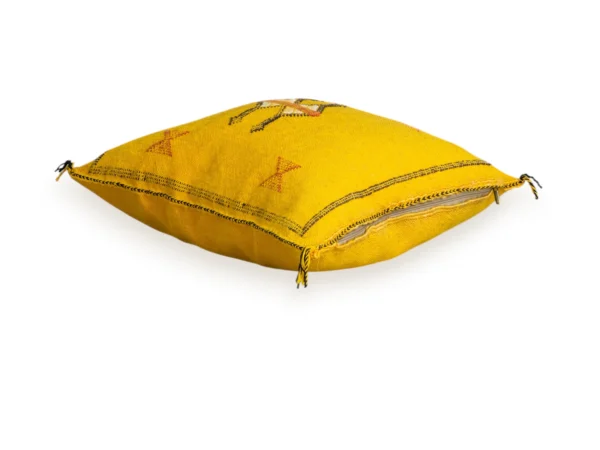
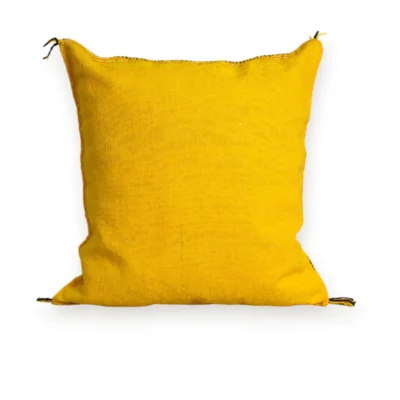
- Finish: Hidden zipper closure · black & yellow piped edge · corner tassels
- Dimensions: Approx. 18 × 18 in (handwoven — slight variations are natural)
- Recommended insert: 20 × 20 in for a full, rounded look (insert sold separately)
A Rare One — One of Two
Only two of this pillow were ever made. One here, and its twin. When they are gone, they are gone — the weaver has moved on to other work, the season is closed, and the exact blend of saffron and madder that colored this batch will not be mixed again. Each piece ships with a numbered certificate of authenticity — 01 of 02 or 02 of 02 — signed by our founder and naming the weaver who carried it from loom to finish. A small paper, but it holds the whole story.
Where This Piece Belongs
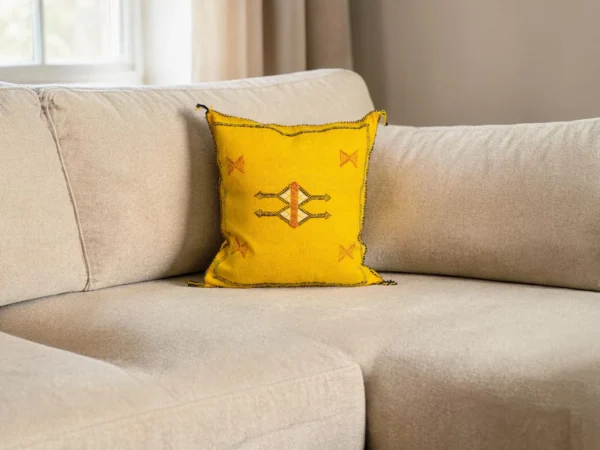
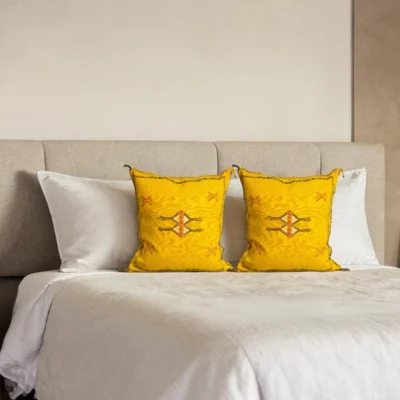
Set against a cream linen sofa, it becomes the warm center of the room. On a gray velvet chair, it softens the cool. On a white linen bed, it reads like morning light arriving early. Layer it with burgundy, deep ochre, or chocolate brown for a room that feels lived-in and considered. It’s the pillow that makes people ask, where did you find that?
One of two. The sheen shifts with the light — sabra silk is a living fiber. Small irregularities in the weave, tassel length, or motif placement are signatures of the artisan’s hand, not flaws.
Because every piece is woven by hand, exact dimensions may vary by up to 1 inch. This is a signature of authentic Moroccan weaving — and one of the reasons each Tigemi pillow is truly one of a kind.



Reviews
There are no reviews yet