FREE U.S. SHIPPING · DHL EXPRESS DELIVERY
ARTISAN-MADE IN MOROCCO · LIMITED COLLECTIONS
Discover Moroccan wool: the Atlas Mountain sheep breeds, traditional processing, natural colors, authenticity tests, and why it's the most durable wool on Earth.
Before there is a rug, there is a sheep. Before there is a sheep, there is a mountain. Before there is a mountain, there is a climate — cold nights, hot days, thin air, stony ground, sparse water. The wool that emerges at the end of this chain is not a generic material. It is a direct translation of a specific landscape into a fiber, and nothing about it can be replicated in a factory or a country with softer weather. Moroccan wool is, in the most literal sense, the Atlas Mountains made wearable, walkable, and warm.
This guide is a complete introduction to the wool traditions of Morocco — where the wool comes from, how the different regional fleeces differ, how wool is processed from the sheep’s back to the weaver’s loom, and why the choice of wool matters more than almost any other decision in the making of a rug, a blanket, or a garment. Whether you are buying a Beni Ourain tomorrow or simply want to understand what makes Moroccan textiles feel the way they feel, this is the foundation.
Moroccan wool is produced almost entirely by breeds of sheep that have been shaped by millennia of life in difficult terrain. The animals are smaller than their European or Australian counterparts, their fleece is denser, and the individual fibers tend to be longer, coarser, and more naturally oily. These are not weaknesses. They are the specifications of a fiber that needs to insulate against cold desert nights, shed mountain rain, and withstand the daily friction of life in a Berber household.
The result is a wool that behaves differently from the fine-spun merino yarns most Western consumers know. Moroccan wool is stronger, more elastic, more resistant to soil, and — critically — it ages. A merino sweater looks best the day you buy it. A Moroccan wool rug looks best thirty years later, when the fibers have compacted, the natural lanolin has redistributed, and the color has settled into its final character. This is the difference between industrial wool and landscape wool.
Morocco recognizes seven indigenous sheep breeds, each adapted to a specific ecological zone. For textile purposes, four of these matter most.
Raised in the Middle Atlas around the town of Timahdite, this is the breed most associated with Beni Ourain rugs. The fleece is long, dense, and ranges from pure ivory through cream to deep natural brown and near-black. Timahdite wool has a particular soft-but-springy hand-feel that gives Beni Ourain pile its characteristic bounce underfoot.
A breed from the eastern high plains, Beni Guil sheep produce a slightly coarser wool prized for its durability. It is the fleece of choice for kilim weaving and for outdoor textiles that need to withstand abrasion. The color palette runs from cream to warm brown, and the yarn takes natural dyes beautifully.
Found primarily in the southern plains and foothills, Sardi sheep produce a medium-fine fleece that spins into smooth, strong yarn. This wool appears often in Azilal rugs and in hand-woven Berber blankets where a slightly less rustic texture is desired.
A southern oasis breed adapted to intense heat and arid conditions, D’man wool is shorter and lighter than mountain breeds. It is less used in pile rugs but appears in some southern flat-weaves and in garments where weight is an issue. The color is almost uniformly cream or light brown.
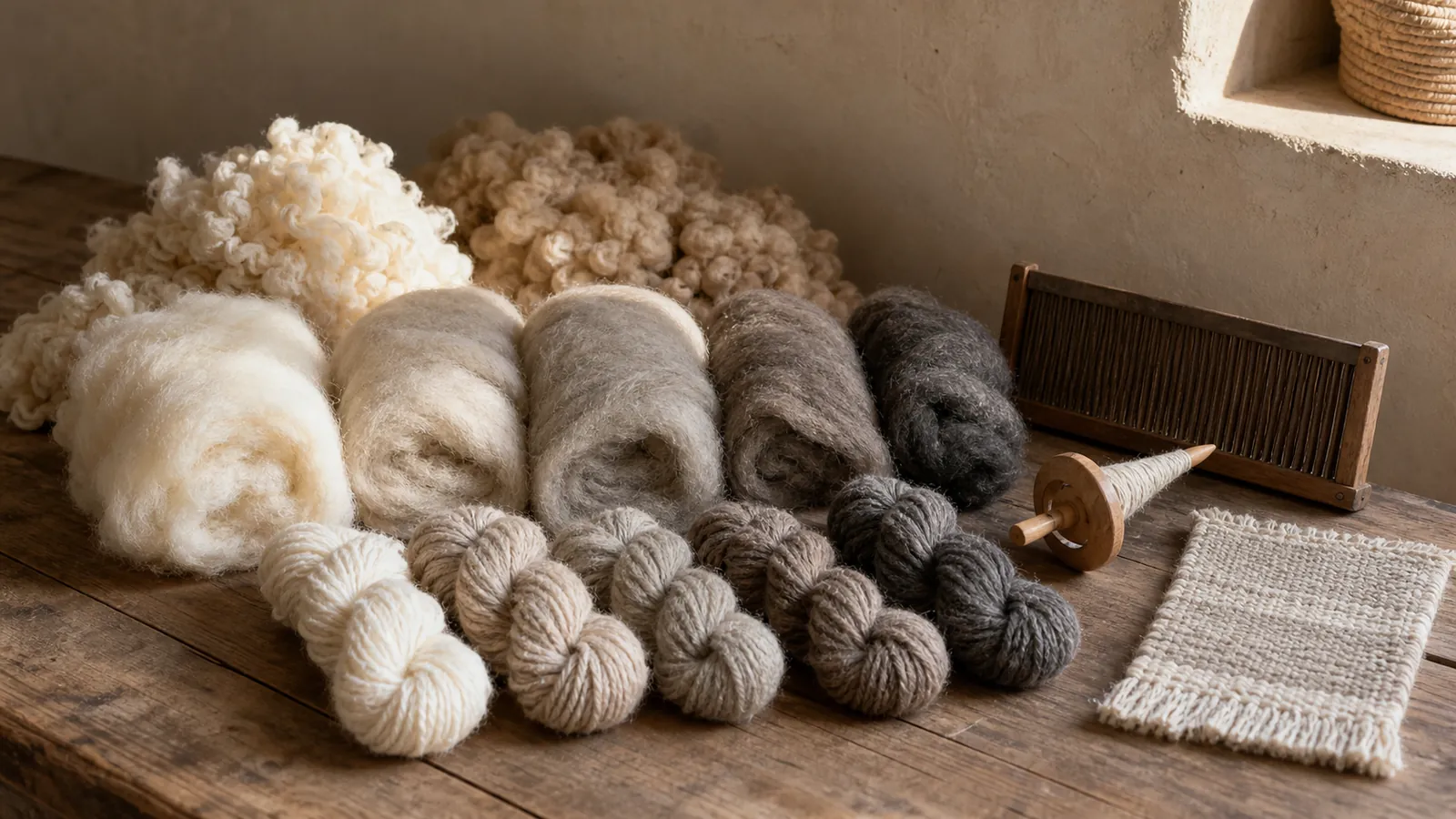
The journey from fleece to finished yarn is entirely manual in authentic Berber production. Each stage is performed by women, usually in their own homes, often across weeks. Understanding the sequence is the fastest way to understand why hand-prepared Moroccan wool feels the way it does.
Sheep are shorn once a year, typically in late spring as the weather warms and the winter fleece reaches maximum length. Shearing is still mostly done with hand shears rather than electric clippers, which preserves the integrity of the longest fibers. The fleece comes off in a single connected piece, called a shear, and is laid out on a clean surface for inspection.
Every fleece contains multiple grades of wool. The wool from the shoulders and back is the longest and finest; wool from the belly and legs is shorter and coarser. A skilled sorter can divide a single fleece into four or five grades, each destined for a different use. The finest wool goes to rug pile. Medium wool goes to kilim weft. The shortest fibers are used for felt or as stuffing.
Sorted wool is taken to a stream, river, or spring and washed by hand. Cold mountain water carries off dust and vegetable matter while preserving the wool’s natural lanolin — the waxy coating that gives authentic Moroccan wool its slightly oily hand-feel and its extraordinary resistance to staining. Industrial wool washing strips lanolin entirely. Traditional washing leaves enough to protect the fiber for the next century.
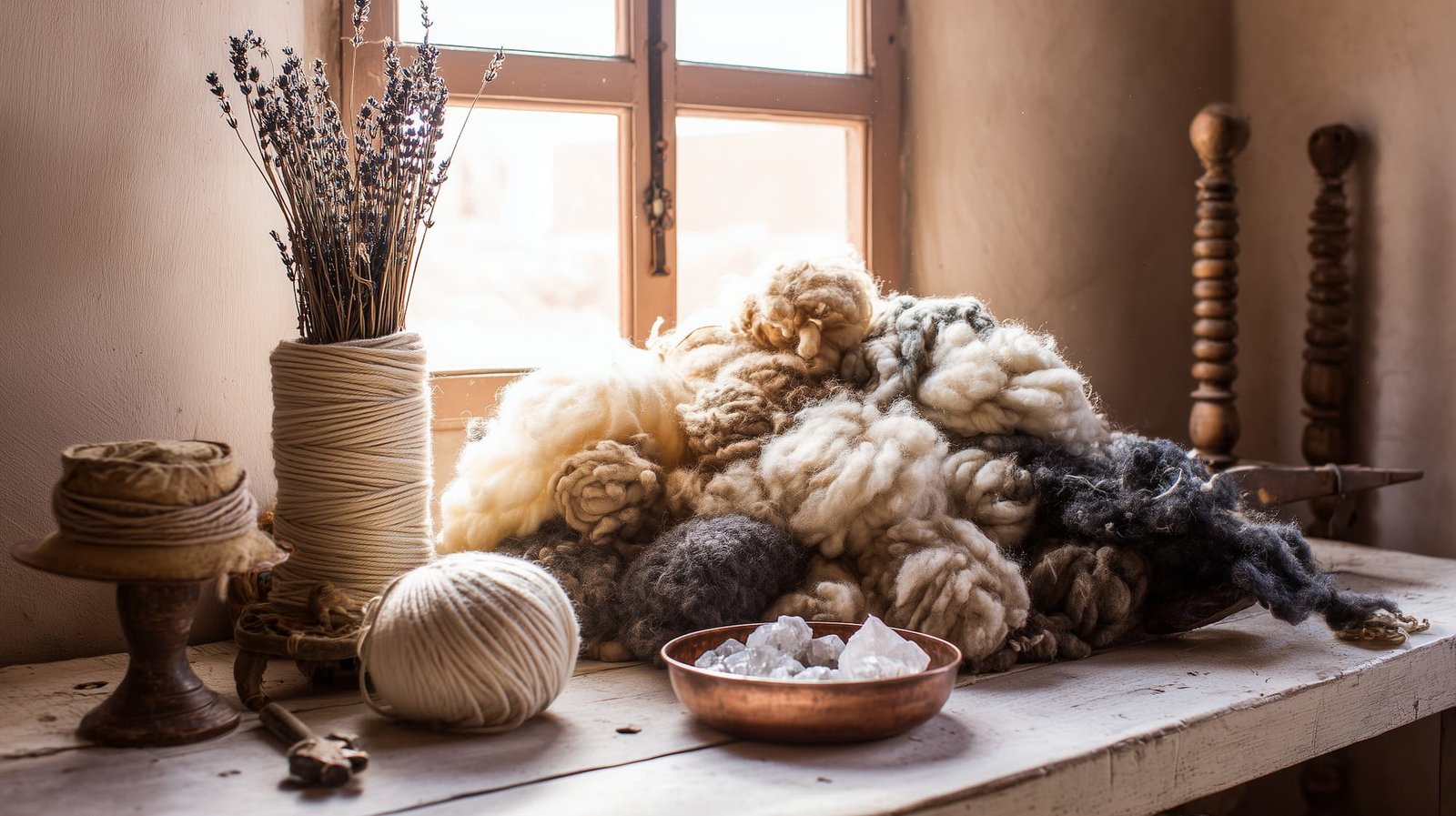
Wool is sun-dried for several days, then carded — brushed with two paddle combs — to align the fibers and remove any remaining debris. Hand-carding produces a loose, fluffy rope of wool called a rolag, which is the direct input to spinning.
Using a drop spindle — a weighted stick spun against the thigh or hanging in the air — the spinner pulls fibers from the rolag and twists them into continuous yarn. Drop spindle spinning has not changed in essentials for at least four thousand years. The slight variations in twist and thickness that result are not defects; they are the signature of human labor, and they give hand-spun yarn its characteristic play of light and texture.
If the yarn is destined for Azilal rugs or colored garments, it is dyed at this stage, before weaving. Dye baths are prepared from plants, minerals, and occasional insects: madder root for red, indigo for blue, walnut for brown, pomegranate for yellow, cochineal for pink. The wool simmers in the dye bath for hours, is rinsed, and is sun-dried again. Natural dyes bond differently with hand-spun wool than with industrial yarn, producing the depth of color that no synthetic can replicate.
One of the distinguishing features of Moroccan wool tradition is the use of natural color. Rather than bleaching or dyeing every fleece white and then dyeing it to the desired shade, weavers sort fleeces by their existing natural color and use that color directly in the rug.
The classic Beni Ourain palette of ivory field and dark geometric motifs is entirely built from these natural wool colors. No dyes are used. The subtle color variations across a single rug come from the fact that different fleeces, even within a single color category, carry their own signature — a slightly warmer cream here, a cooler grey there, a deeper brown in one corner. This is why authentic Beni Ourain wool looks alive.
As Moroccan rugs have become fashionable, mass-market imitations made from synthetic fibers or industrially processed wool have flooded the global market. A few reliable tests will tell you quickly whether you are handling the real thing:
A well-made Moroccan wool rug is one of the most durable textiles human beings have ever produced. It is common to find Beni Ourain or Azilal pieces from the 1950s and 60s still in excellent condition in family homes in the Atlas. The reasons are worth understanding, because they explain why the price of a serious handmade rug is not a luxury indulgence but an investment in decades of use.
Good wool asks for very little. Vacuum gently, without a beater bar, once or twice a week. Rotate rugs every few months to even out wear. Blot spills immediately with a dry cloth — never scrub, which drives the stain deeper into the pile. For serious cleaning, trust only a specialist who works with natural fiber rugs and uses cold water and pH-neutral wool soap. Avoid direct prolonged sunlight on naturally dyed pieces. Never use chlorine bleach or enzyme cleaners. Moths are a real threat — periodic airing in the sun is the traditional defense and still the most effective.
Kept with basic respect, a Moroccan wool rug will pass from you to your children and from them to theirs.
The entire traditional wool chain — shepherd, shearer, sorter, washer, carder, spinner, dyer, weaver — is still, in most villages, operated by women of the same family or the same cooperative. This is one of the few textile economies in the world where the value created at each step can, when the buyer cares, be directly returned to the hands that did the work.
Industrial textile supply chains obscure almost everyone who touches the fiber. Moroccan cooperative wool production makes the chain visible. When you buy a rug or blanket from a brand that names its sources, you are not just acquiring an object; you are funding the continuation of a craft that only survives if weaving remains economically meaningful for the next generation of women.
At Tigemi, every Moroccan wool textile we sell comes from a known source — a specific region, a specific cooperative, and in many cases a specific weaver. This transparency is the whole point.
Not in the merino sense. Moroccan wool is softer than industrial carpet wool but firmer than fine-spun clothing wool. This firmness is the reason it holds its shape over decades of foot traffic.
Most wool allergies are actually sensitivities to the short, prickly fibers of industrial wool, to residual chemical processing, or to lanolin. Hand-prepared Moroccan wool has longer fibers and minimal chemical processing, which many sensitive people tolerate better. Those with a genuine lanolin allergy should consider Sabra silk or cotton alternatives instead.
Clean first. Roll, do not fold — folding creates permanent creases. Wrap in clean cotton muslin, not plastic, which traps moisture and invites mildew. Store in a cool, dry, dark place with cedar or lavender sachets to discourage moths. Air in sunlight once a year.
A new rug will release short loose fibers for the first few weeks of use. This is normal and stops on its own. Vacuum gently during this period and resist the urge to pull at loose threads — trim them with scissors if needed.
Traditionally yes. In the commercial market today, some mass-produced rugs sold as “Moroccan” use imported New Zealand or Eastern European wool. Serious cooperative production still uses local Atlas wool, which is part of what you are paying for when you buy authentic.
When most people shop for a Moroccan rug, they look first at the pattern — the diamonds, the stripes, the ivory field, the colored motifs. These are the things that photograph well and that the internet has taught us to notice. The wool itself is almost invisible in a catalog image. This is an inversion of what actually matters.
A rug with a beautiful pattern and poor wool will look tired in three years. A rug with a simple pattern and exceptional wool will look better in three decades than it did the day you brought it home. The pattern is the rug’s face. The wool is its body, its heart, and its lifespan.
Once you learn to notice wool — the weight in your hand, the feel under your palm, the way light sits on the fibers — you will never shop for textiles the same way again. This is the quiet, slow competence that every serious collector of Moroccan rugs eventually develops. It starts here, with the sheep, and with the mountain they came from.
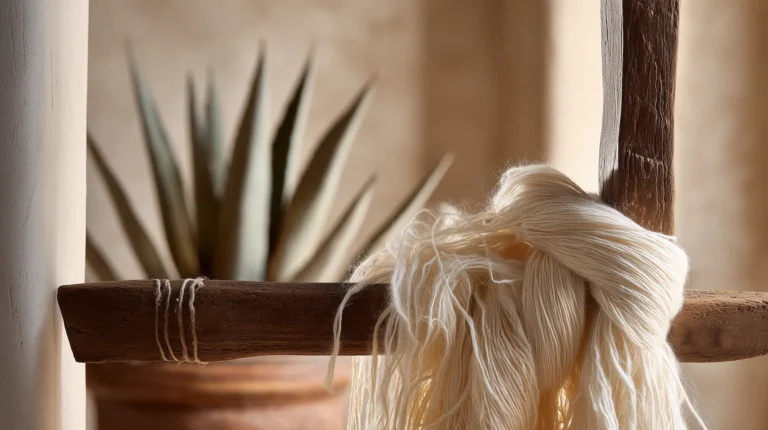
The sheep. The breeds raised in the Atlas mountains grow a long, soft, naturally resilient fleece. Washed gently in cold mountain streams rather than scoured with industrial chemicals, the wool keeps a faint natural lanolin that gives authentic Moroccan textiles their soft, slightly oily hand.
Good highland wool, hand-spun and gently washed, is far softer than most people expect – the tribes originally wove it into surfaces they slept on. Coarseness usually signals lower-grade fleece, harsh chemical washing, or synthetic blending.
Look closely at the yarn. Hand-spun wool varies subtly in thickness along its length, which gives a handwoven pile its living, light-catching texture. Machine yarn is uniform and flat. Those small irregularities are the signature of a human hand at the spindle.
Mostly it just needs gentleness. Vacuum without a beater bar, blot spills immediately rather than scrubbing, rotate pieces so they wear evenly, and trust only a cold-water, pH-neutral wool cleaner for deep cleaning.
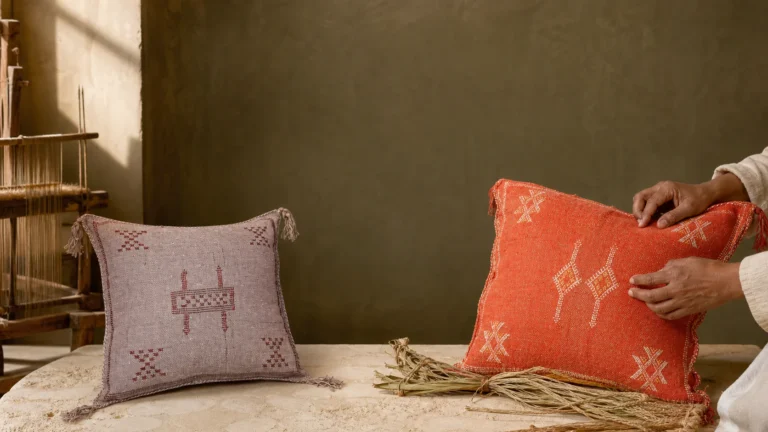
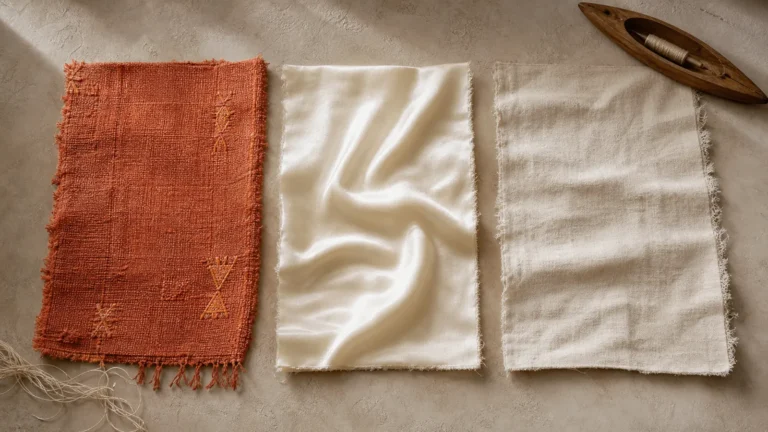
Wool brings warmth and matte softness to a room; cactus silk brings the contrasting note of sheen. The two materials have shared Moroccan homes for centuries – pair your handwoven wool textiles with a Sabra silk pillow and you get depth from the play of matte against luster. Browse our one-of-one Sabra silk pillows; each is handwoven in Morocco, $99, with free worldwide shipping.