FREE U.S. SHIPPING · DHL EXPRESS DELIVERY
ARTISAN-MADE IN MOROCCO · LIMITED COLLECTIONS
Discover Beni Ourain rugs: authentic handwoven Berber wool rugs from the Middle Atlas. Complete guide to origin, symbols, authenticity, styling, and care.
In the high Atlas Mountains of Morocco, among the cedar forests and snow-dusted peaks of the Beni Ourain tribes, a rug tradition has been quietly guarding itself for over a thousand years. These are not decorations. They are biographies — woven in wool, read in symbols, and passed from mother to daughter across generations that predate written language in the region. Today, a single authentic Beni Ourain rug can anchor an entire room in Paris, New York, or Tokyo, yet its creator may never have left the village where her grandmother taught her to weave.
This guide is an invitation into the world of Beni Ourain — the most internationally recognized Moroccan rug and, arguably, the most misunderstood. Whether you are shopping for your first piece, styling a space around one, or simply curious about how a mountain tribe’s craft became a global design language, what follows is a complete map: origin, symbolism, weaving process, authenticity markers, styling, and care.
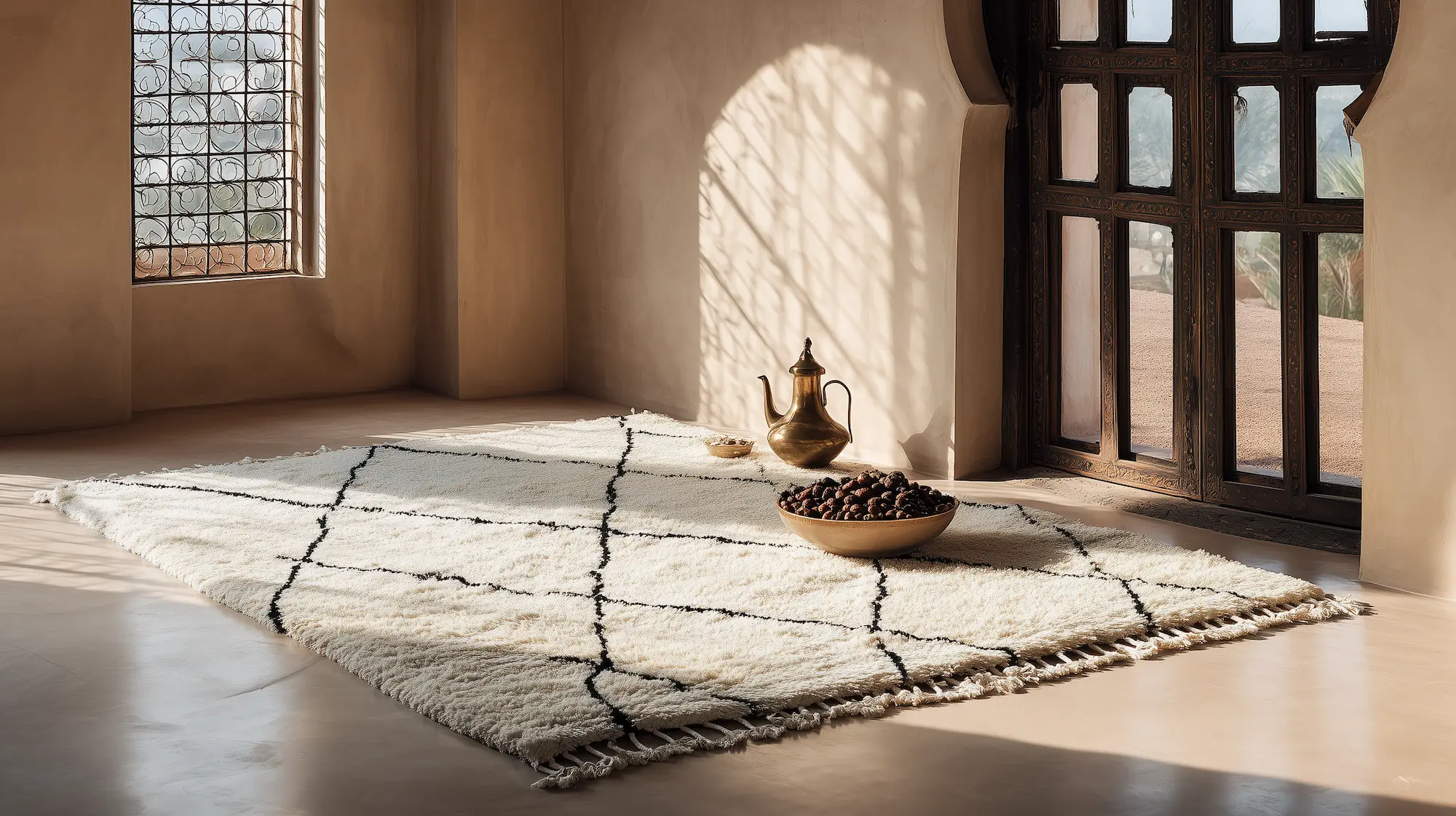
A Beni Ourain rug is a handwoven wool rug produced by the seventeen Berber tribes of the Beni Ourain confederation, who live in the Middle Atlas mountains of northeastern Morocco. Traditionally, these rugs share four defining characteristics: undyed ivory or cream wool as the dominant field, sparse geometric motifs in natural dark brown or black wool, a thick pile designed for mountain warmth, and abstract symbols that carry layered meaning — fertility, protection, lineage, landscape, memory.
Authentic Beni Ourain rugs are made entirely by women, entirely by hand, and entirely from the wool of the tribes’ own sheep — a specific highland breed whose fleece is known for its length, softness, and resistance to soil. No chemical dyes. No machine spinning. No commercial acceleration. A single large rug can take four to eight months to complete.
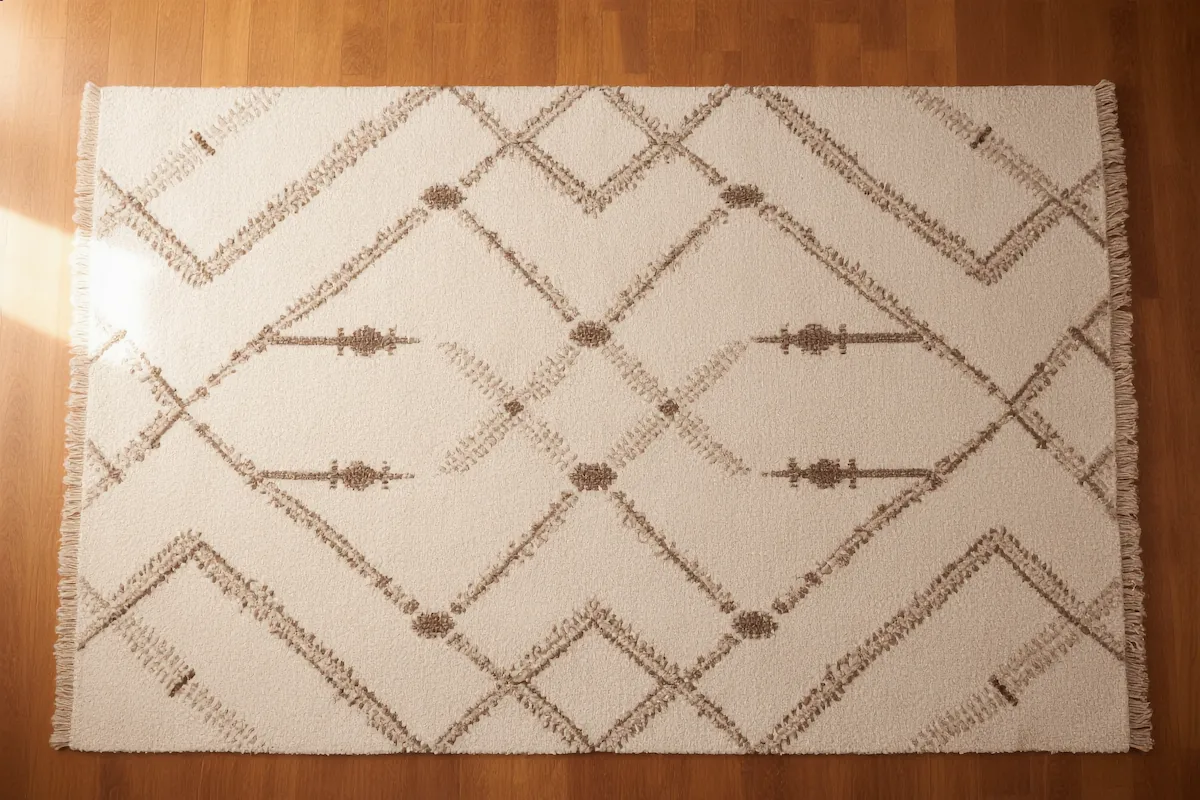
The Beni Ourain (also transliterated as Beni Ouarain or Aït Ouaraïn) are a confederation of Berber tribes whose territory stretches across the provinces of Taza, Boulemane, and Sefrou in the Middle Atlas. Their ancestors are thought to have settled the region during the medieval Berber migrations, though the weaving tradition itself likely predates Islam in Morocco — certain geometric motifs found in contemporary rugs echo patterns on Paleolithic rock carvings in the same mountain ranges.
For most of their history, the Beni Ourain were semi-nomadic pastoralists. Rugs were not made for decoration or commerce. They were made to sleep on, to survive winter, to dress a bride, to swaddle a newborn, to cover the dead. The rugs’ sparse, abstract language developed inside this intimate domestic life — which is why, even today, a genuine Beni Ourain carries a weight that purely decorative textiles cannot replicate.
The making of a Beni Ourain is a slow chain of tasks, each performed by women, often across multiple households in the same village. Understanding the process is the fastest way to understand why authentic pieces cost what they cost — and why machine-made imitations feel immediately wrong once you have seen the real thing.
Each spring, the tribe shears its sheep. The fleece is sorted by color — ivory, cream, dark brown, near-black — and by length. The longest, softest fibers are reserved for the pile of the finest rugs. Shorter fibers go to the warp and weft of the foundation. Nothing is wasted.
The raw wool is taken to a nearby stream or river and washed by hand. The cold, fast water carries off lanolin, dust, and vegetable matter without the harsh soaps that industrial mills use. This gentle wash is one of the reasons authentic Beni Ourain wool retains a soft, slightly oily hand-feel that no machine-washed wool can fake.
Using a drop spindle — a technique unchanged for centuries — each woman spins the clean wool into yarn on her lap, often while tending to children, cooking, or talking with neighbors. Hand-spun yarn is never perfectly uniform, and this is the point. The slight variations in thickness create the characteristic subtle texture of a real Beni Ourain pile, which catches light in a way that factory yarn never will.
Beni Ourain looms are vertical, wooden, and built against the wall of a family home. Setting up the warp — the vertical threads that hold the rug together — is itself a day’s labor and often a communal event. Women help each other tension the warp correctly; a poorly set warp will haunt every knot that comes after it.
The weaver sits on the floor in front of the loom and ties each knot of pile by hand, one at a time, using the traditional Berber knot (similar to a symmetrical Ghiordes knot but looped more loosely to produce a longer shag). Between every few rows of knots, she beats the weft down hard with a heavy iron comb to compact the structure. A medium-sized Beni Ourain contains tens of thousands of individual knots. A large one contains well over a hundred thousand.
Once the rug leaves the loom, the fringes are hand-knotted, loose ends are trimmed, and the entire piece is washed one final time — again in a cold stream — to open up the wool and settle the pile. The rug is then laid out in the sun for several days. This sun-wash is what gives the ivory its particular warm, living tone.
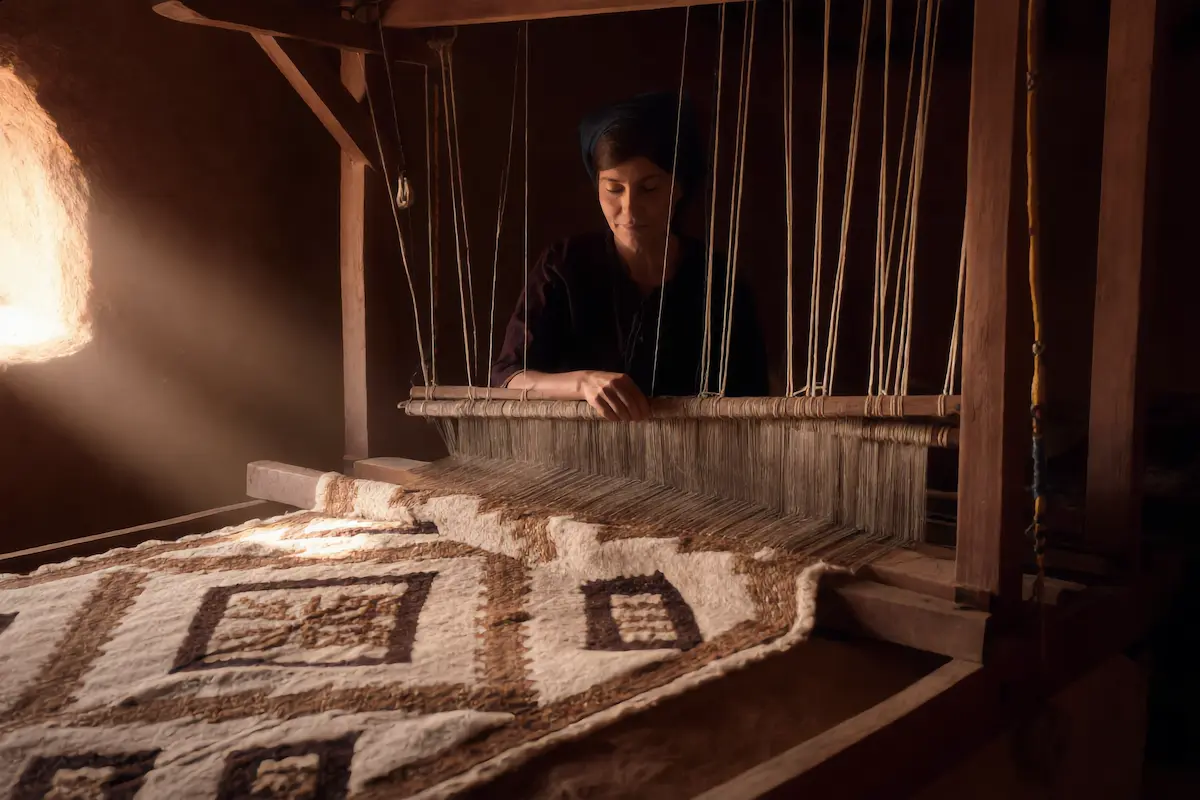
The diamonds, lozenges, zigzags, and asymmetric lines you see on a Beni Ourain are not random. They belong to an old visual language that every weaver inherits and, crucially, adapts. No two rugs are identical because no two lives are identical.
When you live with a Beni Ourain long enough, you stop seeing “pattern” and start seeing a sentence. This is one of the quiet joys of owning one.
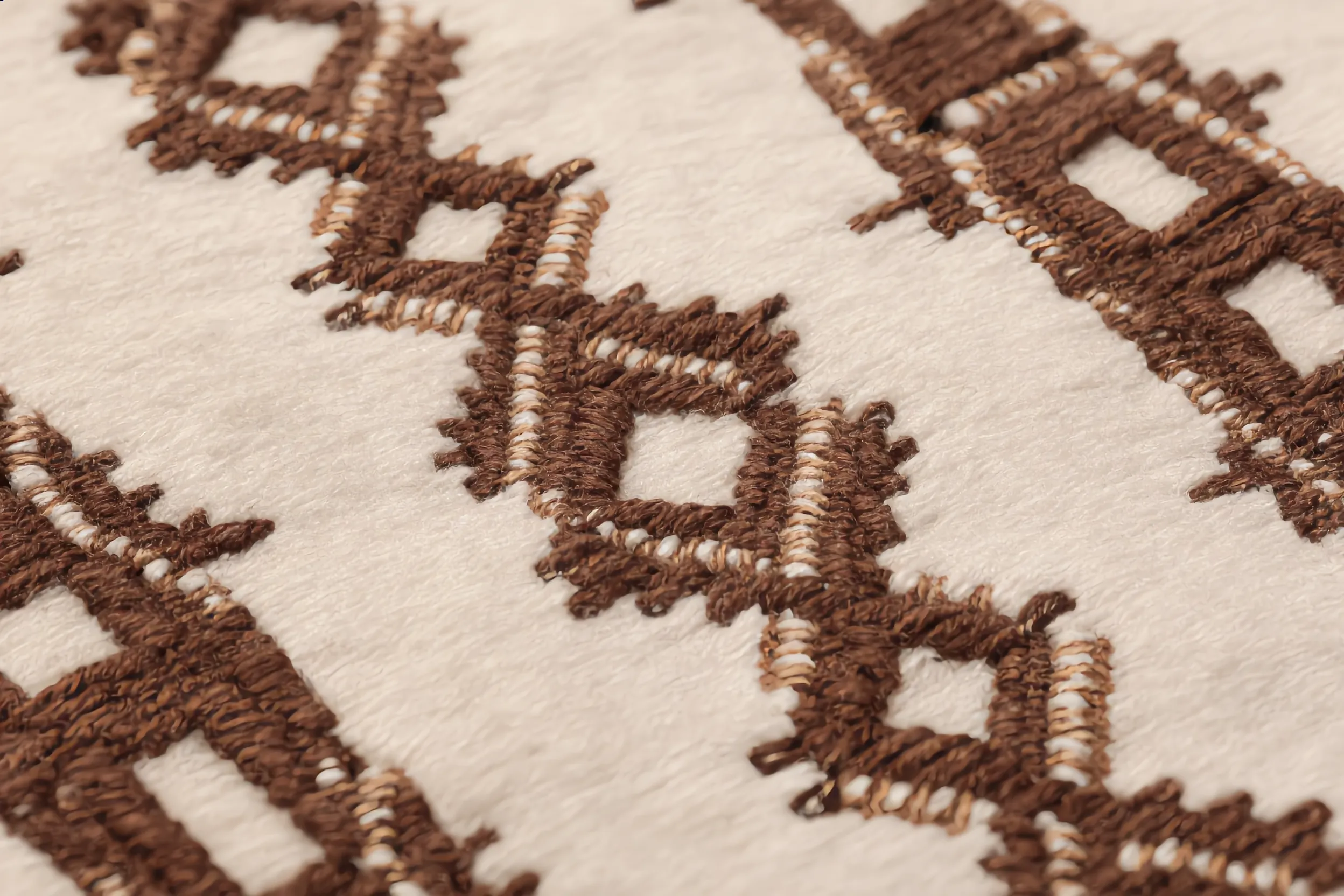
“Moroccan rug” is a category, not a style. Within it, Beni Ourain sits alongside several other distinct traditions, each with its own region, palette, and purpose. A quick orientation:
If you want quiet and architectural, you want a Beni Ourain. If you want color and story, look at Azilal. If you want energy and play, Boucherouite. Understanding this map protects you from paying Beni Ourain prices for a rug that is not actually Beni Ourain.
The international reputation of Beni Ourain was not built by marketing. It was built by the mid-century modernists. In the 1950s and 60s, architects and designers like Le Corbusier, Alvar Aalto, and Frank Lloyd Wright began placing these rugs in their most celebrated interiors. The reason was simple: Beni Ourain’s restrained geometry and unbleached palette were a perfect counterpoint to modernist architecture. The rug gave warmth to concrete, softness to glass, and humanity to steel.
Seventy years later, the same principle holds. A real Beni Ourain works in a minimalist loft, a traditional townhouse, a scandi-japandi bedroom, or a quiet gallery — because its design vocabulary is ancient enough to sit comfortably next to anything contemporary.
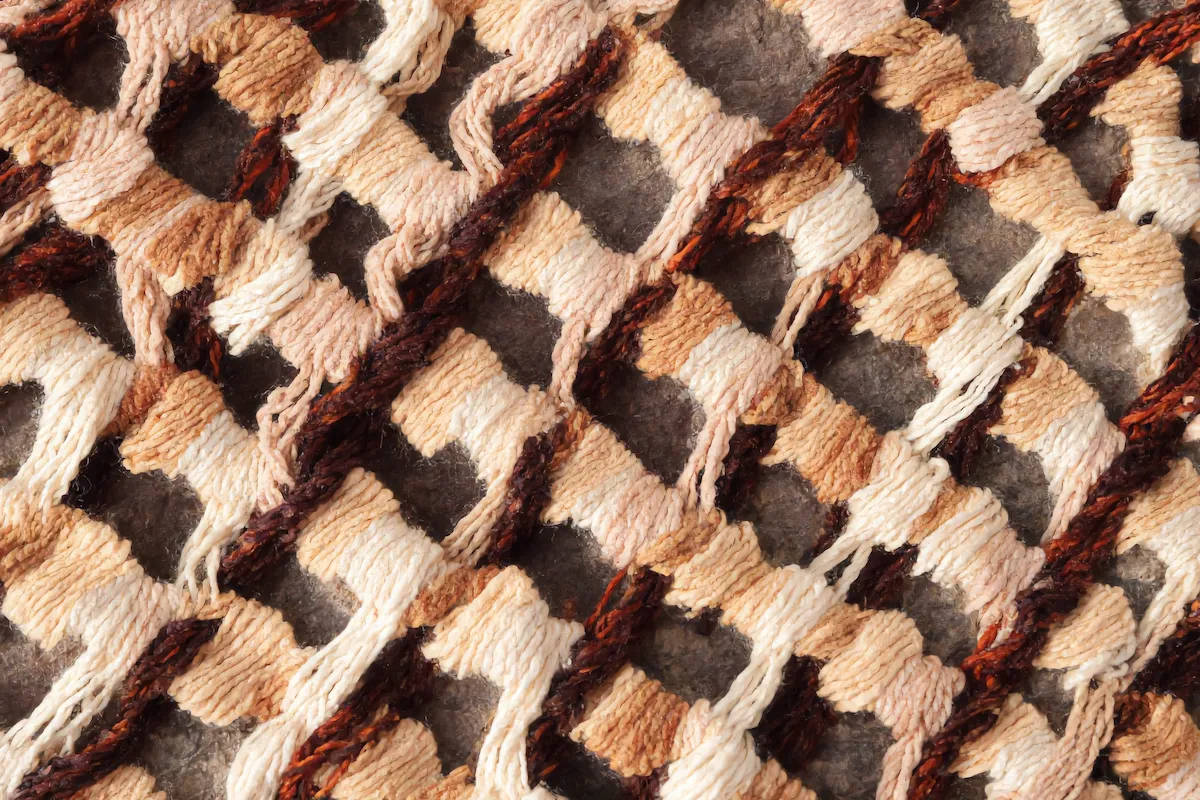
Hand-knotting a Beni Ourain — one knot at a time, by hand, in the mountains.
The global popularity of the style has produced an ocean of imitations — machine-tufted, synthetic-fiber, factory-dyed rugs sold as “Beni Ourain style” or, more deceptively, as “Beni Ourain” with no qualifier. A few reliable tests:
Beni Ourain is forgiving but not invisible. A few principles from our own styling work with clients:
Good wool, well made, cared for simply, will last a century. Vacuum gently without a beater bar. Rotate the rug every few months so it wears evenly. Blot spills immediately with a dry cloth — never scrub. For deeper cleaning, trust a professional wool cleaner who uses cold water and pH-neutral soap, not a general carpet steaming service. Avoid direct sunlight for long periods, which can slowly bleach the dark motifs.
A Beni Ourain rug that passes through too many middlemen arrives at your home carrying very little value for the woman who wove it. When you buy directly from a cooperative or a brand with transparent weaver relationships, a meaningful percentage of what you pay returns to the artisan and her village. In practice, that means school fees, healthcare, and the continuation of the craft itself — because young women only learn to weave if weaving is economically worthwhile.
At Tigemi, every Beni Ourain in our collection is sourced directly from known weavers in the Middle Atlas, photographed with their permission, and priced with a clear share returning to the cooperative. This is not a marketing claim. It is the reason we exist.
Authentic, hand-knotted Beni Ourain rugs typically range from around €800 for a small vintage piece to €5,000 or more for large contemporary pieces from recognized weavers. Prices under €300 for a “Beni Ourain” of any meaningful size almost certainly indicate a machine-tufted imitation.
Yes. The long pile and highland wool make them exceptionally soft — one of the reasons the tribe originally wove them for sleeping surfaces. They are also surprisingly warm in winter and cool in summer, because wool is a natural thermoregulator.
Yes, though the ivory field will show more wear and soil than a darker rug. Rotate it regularly and choose a denser, shorter-pile piece for entryways and hallways. In living rooms and bedrooms, a standard pile is ideal.
No. Several Moroccan tribes and many non-Moroccan factories produce rugs inspired by the style. True Beni Ourain comes specifically from the seventeen tribes of the Middle Atlas confederation and follows the material and technical markers described in the authenticity section above.
A Beni Ourain rug is not an acquisition. It is a relationship — with a weaver, a mountain, a language, and eventually with your own home as it changes around the rug. Buy slowly. Ask questions. Learn the symbols. And when you finally bring one home, unroll it on the floor, walk on it barefoot, and notice how the room quiets down around it.
This is what a thousand years of weaving feels like underfoot.
Properly cared for, a hand-knotted highland-wool Beni Ourain will comfortably outlast its first owner. The same qualities that made the tribes weave them for sleeping – dense, slightly oily wool and a tight hand-knotted foundation – make them genuinely generational textiles.
Because it is undyed. Authentic Beni Ourain wool is washed in cold mountain streams and sun-dried rather than bleached, so the field ranges from cream to warm beige. A flat, uniform, brilliant-white “Beni Ourain” is almost always machine-made and chemically treated.
Yes. The rug’s restraint is an asset in compact spaces – its open ivory field makes a room feel larger and quieter. Choose a size that lets a few inches of floor breathe around it.
Not in a formal sense. The diamonds, zigzags, and crosses belong to an older Berber visual language about fertility, water, protection, and lineage. The deliberate asymmetry many weavers include is itself a quiet acknowledgment that only God creates perfection.
A Beni Ourain gives a room its quiet foundation; the finishing note is texture and a whisper of color at sitting height. Many of our clients pair the rug’s undyed restraint with a single handwoven Sabra silk pillow – the cool, pearlescent sheen of cactus silk is a natural counterpoint to all that calm wool. You can browse our one-of-one Sabra silk pillows here; each is handwoven in Morocco, $99, with free worldwide shipping.