FREE U.S. SHIPPING · DHL EXPRESS DELIVERY
ARTISAN-MADE IN MOROCCO · LIMITED COLLECTIONS
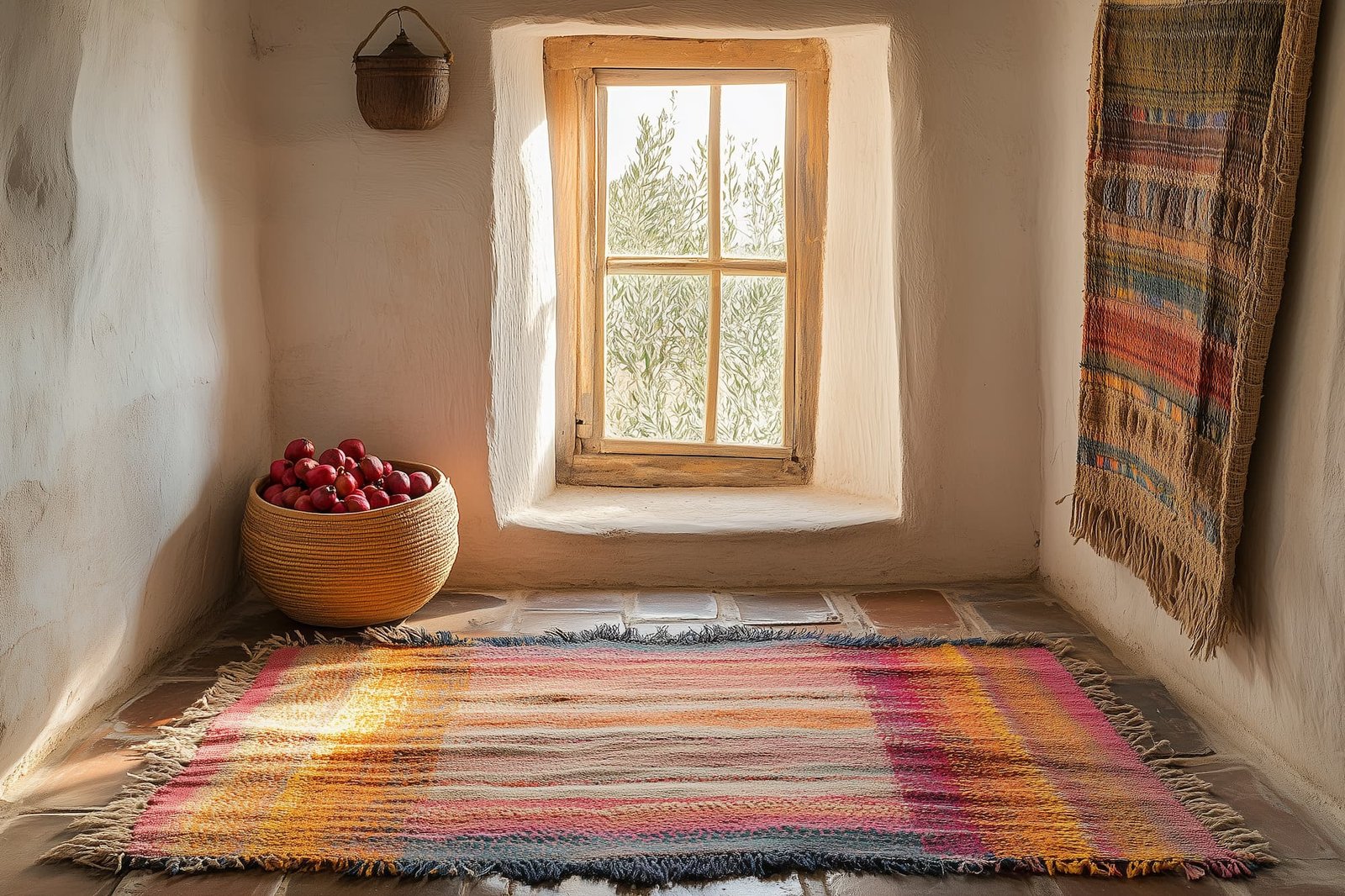
Discover Boucherouite: Morocco's recycled rag rug tradition. A complete guide to origin, weaving process, authenticity markers, styling, care, and why it matters now.
In a mountain village in the Atlas, a grandmother unwinds an old wedding dress. She cuts it into strips, knots the strips into a ball, and begins a new rug. The red of the dress meets the blue of a child’s outgrown shirt, meets the yellow of a tablecloth that once covered a funeral meal, meets the green of a curtain from a house that no longer exists. This rug, when it is finished, will be called a Boucherouite — and it will contain, quite literally, the fabric of a family’s life.
If Beni Ourain is Morocco’s quiet architectural rug, Boucherouite is its joyful, improvisational cousin. It is the rug that most Western buyers have never heard of, yet once you understand it, it becomes almost impossible to walk past one without stopping. This guide is a complete orientation to the Boucherouite tradition: where it comes from, how it is made, why it looks the way it does, how to recognize an authentic piece, how to live with one, and why it may be the most honestly sustainable textile in the world.
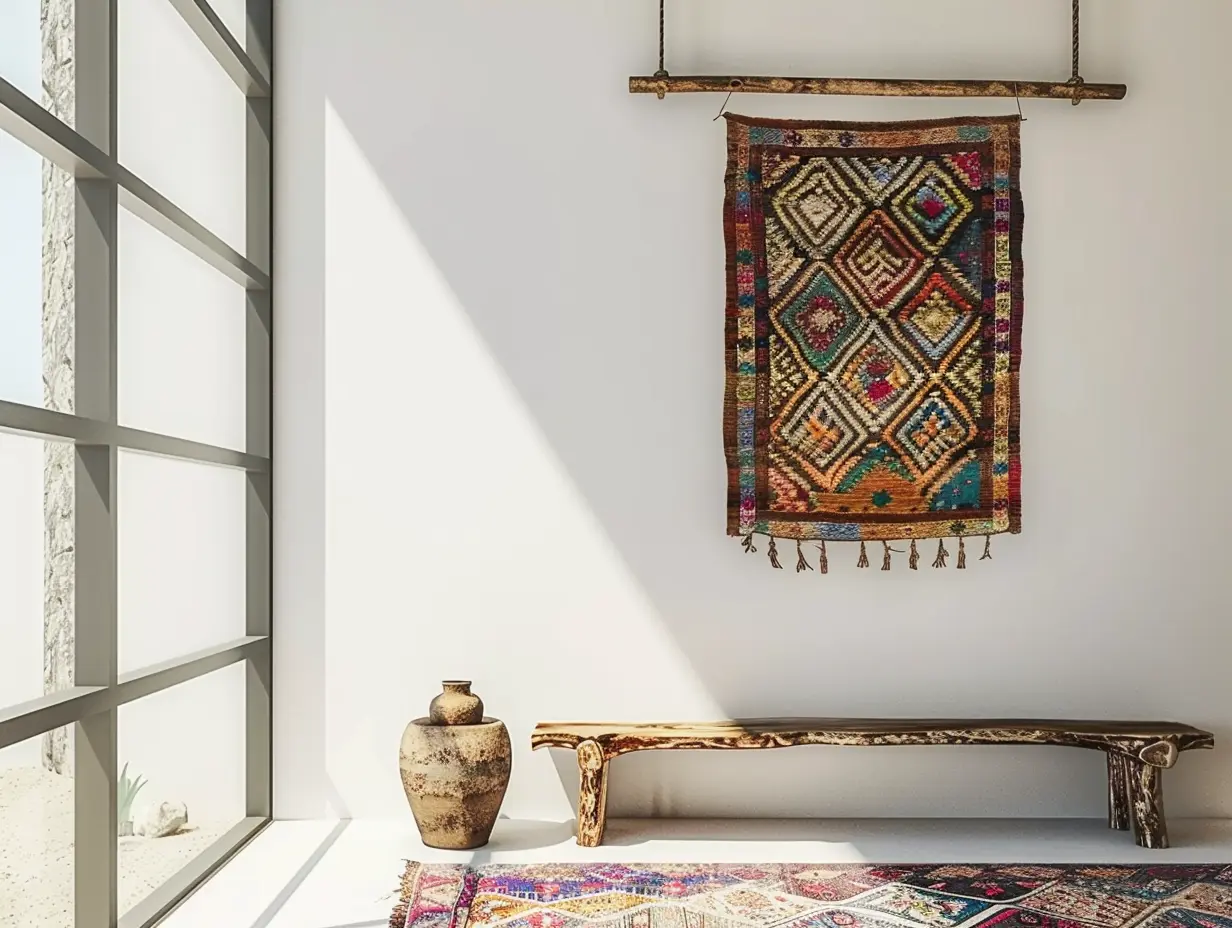
A Boucherouite (also spelled Boucherwite, Boucharouette, or Bouchérouite) is a Moroccan rag rug woven from recycled textiles — old clothing, worn-out blankets, discarded fabric scraps, and sometimes small amounts of leftover wool. The name itself comes from the Moroccan Arabic word bouchrwit, which roughly translates as “a piece torn from used clothing.” The rug is named, in other words, after its raw material: scraps.
What makes a Boucherouite remarkable is not the fabric but what the weaver does with it. Rather than hiding the mismatched origins of her materials, she composes with them — building explosions of color, unexpected geometries, and visual rhythms that no trained designer would ever plan. The result is a textile that is simultaneously utilitarian, autobiographical, and, by accident, one of the most visually adventurous craft objects made anywhere in the world today.
Boucherouite is a relatively young tradition. Most historians date its emergence to the mid-twentieth century, when several pressures converged on rural Moroccan households at once: rising wool prices, the gradual disappearance of family flocks as young men migrated to cities for work, and the growing availability of cheap synthetic textiles in local markets. Women who had been weaving pile rugs from their own wool for generations suddenly found themselves without wool — but with an increasing stockpile of worn-out clothes.
Rather than give up weaving, they adapted. The loom stayed. The knots stayed. The symbols stayed. Only the yarn changed. A tradition that might have died instead became something entirely new.
For decades, Boucherouite rugs were considered domestic objects of no commercial value — made inside the home, for the home, sometimes as practice pieces for young weavers learning their craft. It was only in the late 1990s that European and American dealers began to recognize them as an important folk-art tradition. Today, museum collections from Paris to New York hold Boucherouite rugs, and a strong piece from a recognized weaver can command serious prices in international galleries.
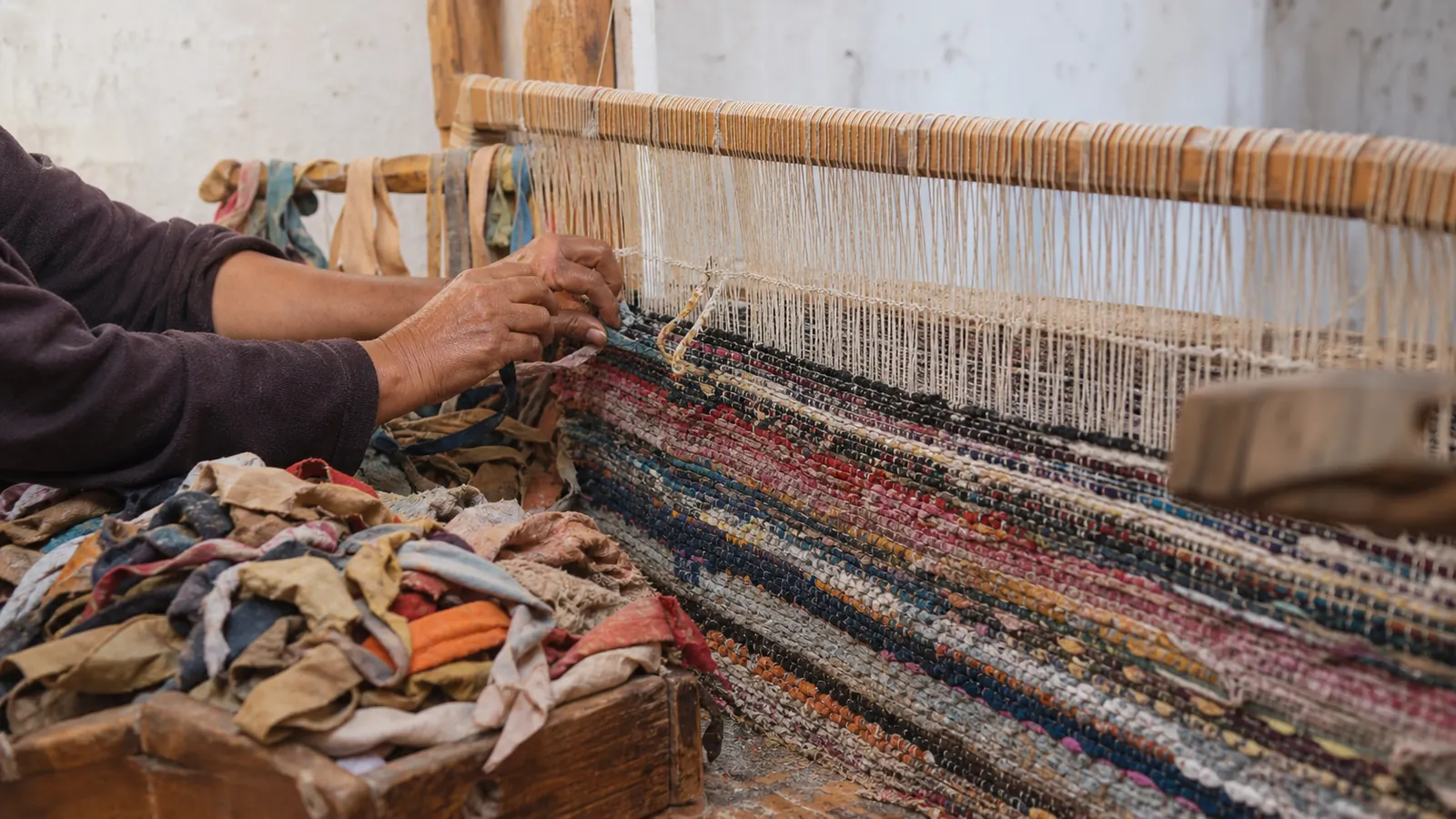
The Boucherouite process is deceptively simple. Watch it happen and you will understand immediately why the rugs feel so alive — every step is an act of judgment, performed by the weaver alone, with no sketch, no plan, and no supervisor.
The weaver collects worn clothing, sheets, curtains, and fabric offcuts from her household and, often, from neighbors and relatives. Nothing is bought new. Synthetic fabrics, cotton, wool blends, lace, knits, and woven cottons all end up in the pile. The more diverse the sources, the more visually interesting the final rug.
Garments are cut at the seams and torn into long, narrow strips — usually between one and three centimeters wide. Heavier fabrics are cut narrower. Delicate fabrics are cut wider. The strips are then knotted end to end into one continuous length and wound into balls. These balls of recycled yarn are the weaver’s palette.
The warp threads — the vertical structure that holds the rug together — are usually made from stronger material: hand-spun wool, cotton twine, or sometimes synthetic cord. A vertical loom is set up against the wall of the home, exactly as it would be for a traditional wool rug. The foundation is invisible in the finished piece, but its strength determines how long the rug will last.
This is where Boucherouite becomes itself. The weaver picks up a ball of strips, ties a few rows of knots, sets it aside, picks up another ball in a different color, ties a few more. There is no cartoon, no plan, no reference image. Compositional decisions are made in real time, across weeks of work. Colors that clash get reconciled by the next row. Geometric intentions get abandoned, rediscovered, subverted. Each rug is a record of the weaver’s visual mind changing itself over the course of months.
When the rug reaches the planned length, it is cut from the loom, the warp ends are knotted into fringes, and the piece is shaken out and hung in the sun for a day. Unlike wool Beni Ourain rugs, Boucherouite pieces are not washed in streams — water would damage the mixed synthetic content. The rug is simply aired, brushed, and rolled up.
To a Western eye trained on Beni Ourain’s restraint, the first encounter with Boucherouite can be jarring. Pinks next to oranges. Stripes interrupted by diamonds interrupted by pure fields of electric blue. Irregular borders. Deliberate asymmetry. There is a temptation to read this as “primitive” or “naive,” and it is worth setting that reading aside immediately.
Boucherouite’s visual language emerges from three real constraints, each of which becomes an artistic tool in the hands of a skilled weaver:
This is why a strong Boucherouite does not feel random, even when it looks unplanned. It feels decided — relentlessly, confidently decided, row by row, across months of the weaver’s time.
Because these three traditions are often sold under the umbrella term “Moroccan rug,” it helps to understand what separates them:
If you want quiet, choose Beni Ourain. If you want story and color in harmony, choose Azilal. If you want maximum energy, expression, and sustainability, Boucherouite is the answer.
Every Boucherouite rug prevents several kilograms of textile waste from being burned or dumped. In a world where the global fashion industry produces over ninety million tons of textile waste per year, the math of Boucherouite is almost shocking: it is a circular textile economy that predates the word “circular” by half a century, developed not out of ideology but out of practical necessity.
A single medium-sized Boucherouite can contain the fabric of fifteen to thirty garments. Multiply that by the thousands of rugs made each year in Moroccan villages, and the environmental footprint is meaningful — especially when compared to mass-produced synthetic rugs whose lifecycle ends in a landfill.
If you care about slow, circular, zero-waste design, Boucherouite is not a trend. It is a model.
As Boucherouite has entered the international market, imitations have followed — factory-tufted rugs designed to look improvisational, often made from new synthetic yarn rather than recycled material. A few markers separate the real from the costume:
A Boucherouite rewards a little intention in how you place it. A few principles from our own styling work:
Boucherouite care is simpler than wool rug care, with one important difference: most pieces should not be wet-cleaned. Because the fibers are mixed and often include cottons and synthetics that behave unpredictably when wet, water cleaning can shrink, fade, or distort the rug.
Instead: vacuum regularly on a low setting without a beater bar. Rotate the rug every few months. Spot-clean small spills with a dry cloth, blotting rather than rubbing. For deeper cleaning, trust only a specialist who explicitly works with mixed-fiber textiles. Never steam-clean a Boucherouite. Never put it in a washing machine, regardless of size.
Kept carefully, a Boucherouite will outlive you. Kept carelessly, it will still probably outlive most things in your home.
Because Boucherouite historically had no commercial value, many rugs in the international market today were acquired from rural households at prices far below their artistic worth. This is a real concern. The best way to buy a Boucherouite ethically is to buy from a source that can name the cooperative or the weaver, that shares a transparent margin with the artisans, and that understands these rugs as art rather than commodity.
At Tigemi, every Boucherouite in our collection is sourced directly from women’s cooperatives in the Atlas and southern regions. We pay the weavers what serious folk art is worth, not what the wholesale market dictates. This is not optional in our model; it is the reason we built it.
Authentic Boucherouite rugs typically range from around €300 for small vintage pieces to €3,000 or more for large, strong compositions from recognized weavers. Very cheap rugs sold as “Boucherouite” under €100 are almost certainly factory tufted imitations.
Yes, when properly made. The warp foundation determines longevity far more than the pile material. A well-warped Boucherouite will last decades of normal residential use. Avoid placing them in very high-traffic commercial settings.
No. Because of the mixed-fiber content, home washing can shrink, bleed, or distort the rug. Use dry cleaning methods for small spills and a specialist for deeper cleaning.
Generally yes. Because most pieces contain limited wool, they are often better tolerated by people with wool sensitivities than traditional Beni Ourain rugs. However, verify the fiber content with the seller if allergies are a concern.
No. Rag rugs exist in many cultures — American rag rugs, Scandinavian trasmatta, Indian chindi. Boucherouite refers specifically to hand-knotted pile rugs made by Moroccan Berber weavers using recycled textiles. The knotting technique and the Berber symbolic vocabulary are what distinguish it.
We live in a moment when the fashion industry is publicly struggling to reinvent itself around circularity, when designers are being asked to stop creating and start recycling, when a serious question is being asked about whether luxury and sustainability can coexist. The answer to that question has been woven on Moroccan looms for more than sixty years.
A Boucherouite is a complete model of what the future of textile could look like: made slowly, made by hand, made from what already exists, made by women in their own homes, made with an artistic confidence that no algorithm will replicate. Bring one home and you are not only buying a rug. You are underwriting a way of working that predates, and will outlast, the industry that currently dominates your wardrobe.
That is why we weave them. That is why we sell them. And that is why, in twenty years, when the rest of the design world has finally caught up, the women of the Atlas will still be doing what they have always done — turning the fabric of yesterday into the floor of tomorrow.
Because they are composed in real time from whatever recycled fabric the weaver has on hand – old clothing, curtains, worn blankets – with no sketch or reference. The inventory of scraps and the weaver’s row-by-row decisions make each rug a unique record of her materials and judgment.
Often, yes. Because most pieces are woven largely from recycled cotton and synthetic textiles with little or no wool, they tend to be better tolerated than a dense wool rug. If allergies are a real concern, confirm the fiber content with the seller.
Absolutely – museums have hung them for two decades. Their intense color and improvisational geometry make smaller pieces work beautifully as textile art. Use a flat wooden dowel or fabric tabs rather than nailing through the rug.
It is a circular textile economy that predates the word “circular” by half a century. A single medium-sized rug can contain the fabric of fifteen to thirty garments, diverting kilograms of textile waste from landfill.
A Boucherouite wants the spotlight, so the rest of the room should stay calm. The trick we use is to echo just one of its hues at sitting height – pair these joyful rag rugs with a single handwoven Sabra silk pillow in a solid, complementary tone, and the whole composition settles. Browse our one-of-one Sabra silk pillows here; each is $99 with free worldwide shipping.